Former Head of the University of Glasgow Dental School; Scottish Lead for the Scottish Government funded MalDent Project; Chair of the Scotland Malawi Partnership
Phase 1 of the refurbishment of the Dental Department at Kamuzu Central Hospital in Lilongwe took place last May. Joint work is now underway with Dentaid and Henry Schein Dental for Phase 2, which will allow replacement of the remaining original dental chairs and installation of a further six phantom head units. We have, therefore, been on the lookout for additional Belmont dental chairs that can be serviced by Dentaid and then shipped to Malawi.
Recently, NHS Highland kindly agreed to donate a Belmont PRO II chair, which would need to be collected from Inverness. Through contacts of Smileawi, we were also made aware of a chair that was available from a practice in Dunblane. I spoke to my good friend Mike Broad, who had accompanied me previously when we drove 16 dental chairs down to Dentaid in Salisbury, and he kindly agreed to accompany me on a trip in a white van to collect these two items.
We set out at 7am in our hire van and made good time on the trip North. With its sections of single and dual carriageway covered by average speed cameras from Dunblane to Inverness, the A9 can be a frustrating road to drive, but the scenery is tremendous.
Lovely scenery – and a mist hanging over the fields
We had agreed on a break at the House of Bruar for a bacon roll and coffee, but our plan was dashed when we arrived 35 minutes before the café opened at 9.30am!
At House of Bruar, with our lovely new van – but no bacon rolls!
We carried on up to Aviemore and headed for an alternative pit stop known to Mike – The Coffee Corner.
We enjoyed a fantastic breakfast roll and coffee, before continuing our journey to the Centre for Health Sciences on the Raigmore Hospital Campus.
Phase 1 of the trip completed – arrival at the Centre for Health Sciences in Inverness
We arrived about an hour earlier than we had anticipated, but everything was ready for us as promised by Anne Frame, the Operational Manager of the Dental Department, so many thanks Anne! Thanks also to Amanda Clark, the Clinic Head Dental Nurse -Unscheduled Dental Care, who greeted us at the Inverness Dental Centre and showed us the chair, which was perfect for our needs. We had brought with us a skateboard trolley, kindly lent to us by our Glasgow Dental Hospital porters, which made moving the chair straightforward. We took it out through a fire escape door which had a ramp and from there it was straight onto the tailgate lift and into the van.
Mike and chair, ready to ascend!
Following an introduction from Elizabeth Emery Barker, a 2009 Glasgow Dental School graduate who had travelled to Malawi in 2006 with Students for Kids International Projects, we had also arranged to meet with one of her colleagues, Dr Fary Johnson Vithayathil. Both work at Wick Dental Practice and Fary had kindly offered to donate some dental instruments that would be suitable for the pre-clinical skills facility in Lilongwe. He met us at the Health Sciences Centre for the handover.
A box of instruments from Fary, destined for the pre-clinical skills facility in Lilongwe
Whilst we waited for Fary we enjoyed some lunch in the van, courtesy of the picnic that had been prepared by Mike’s wife, Rosie.
A trucker’s picnic underway – thanks to Rosie!
The second chair was to be picked up from Stuart Howie’s former practice in Dunblane High Street. We set off back down the A9 and encountered some very heavy rain and strong winds. We knew that the surgery was on the first storey of a tenement and that the chair would be tricky to extract. My good friend Will McLean lives in Crieff and kindly offered to drive across with his son, Fin, to help Mike and I to transfer the chair to the van.
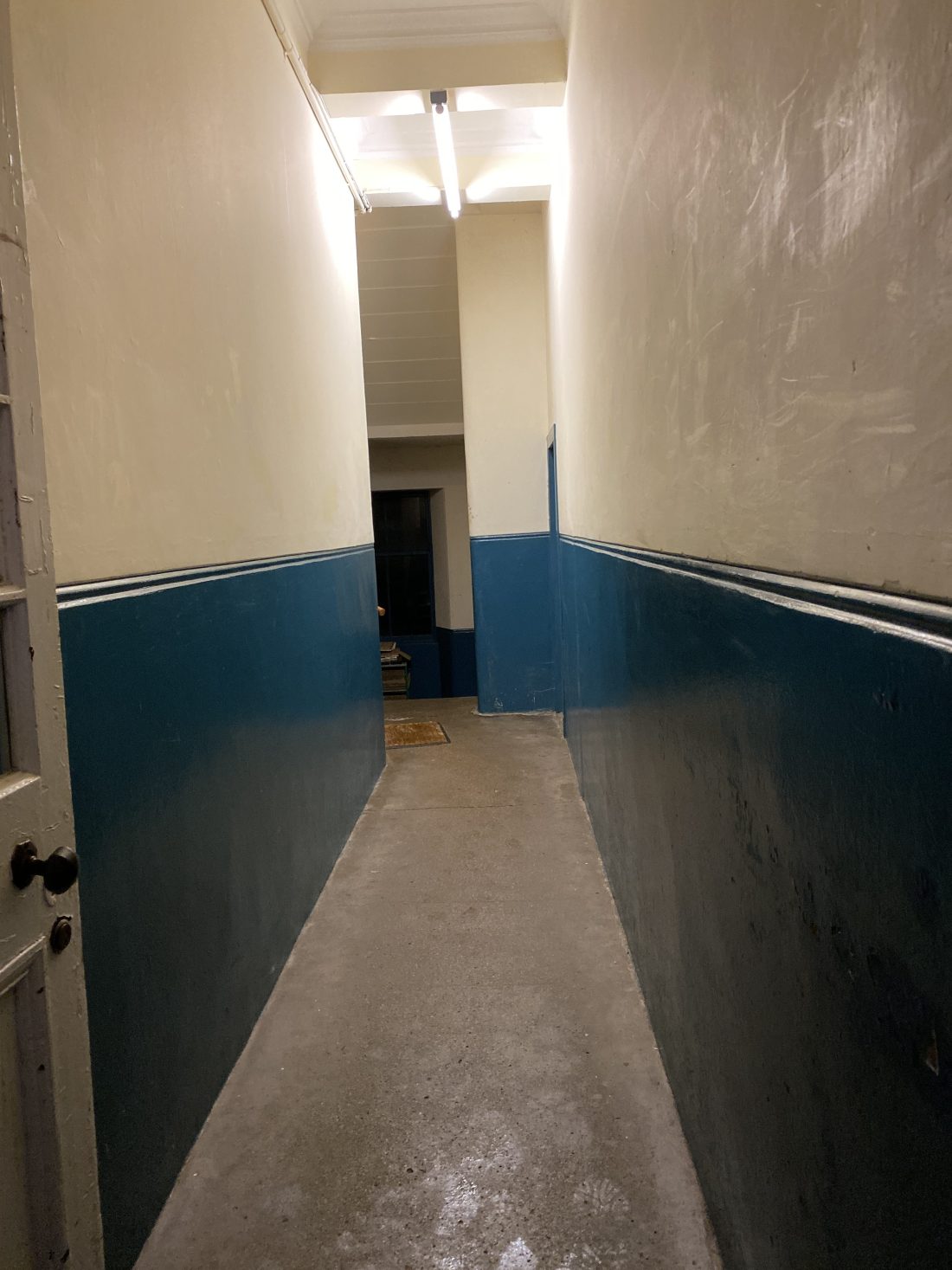
On our arrival in Dunblane, Stuart’s wife Elizabeth was waiting for us outside the practice. The surgery was reached via a corridor from the street:
The corridor
followed by two flights of concrete stairs:
A tricky curve at the bottom of the stairs – negotiated safely in the end!
Stuart had suggested that ropes and a carpet may be the answer to a safe removal of the chair. Heeding this advice, Mike had brought a long roll of carpet and Stuart had provided rope, so we had the gear!
Mike with the rope, ahead of the actionThe red carpet is out for our important but fragile passenger!
With the help of Will and Fin we managed to negotiate the two flights of stairs without damage to the chair, the building or ourselves and the chair was soon lashed securely inside the van.
Mike, Will and Fin as we prepared to tackle the second flight of stairs
After bidding farewell to Elizabeth, we headed to a local hostelry where we enjoyed a very tasty meal.
Great food and atmosphere in The Riverside
It had been a very successful day and it was really enjoyable to sit and chat for an hour over some very good fish and chips.
Happy and replete, thanks to the hospitality at The Riverside
The final leg of the journey took place early on the Monday morning, when the chairs were off-loaded at Glasgow Dental School for temporary storage until we drive them down to Dentaid’s HQ in Southampton.
Ready for unloading at Glasgow Dental Hospital, early in the morning.
Paul our Head Porter and Alan from our Estates Department both helped us to unload the van and then headed into the lift with the chairs to take them down to their temporary storage space in the hospital basement.
Off to the basement with a smile!
Hopefully we will soon be extracting the chairs once again, in addition to many other items we have collected, and filling up another van for the trip to Dentaid in Southampton as the kit prepares for its ocean voyage to Mozambique and then on by road to Lilongwe.
Many thanks to John Lyon of NHS Highland and to Stuart Howie for donating the chairs, Fary Johnson Vithayathil for the instruments and to Mike, Will, Fin, Paul and Alan for all their help with the logistics – much appreciated. Thanks also to Elizabeth Emery Barker for making the original connections for us with NHS Highland and Fary.
The MalDent Project is impacting on many aspects of the academic work of Glasgow Dental School and this was especially evident during the week beginning Monday 2nd December 2019.
On Tuesday 3rd December we enjoyed Graduation Day for our postgraduate students who had completed the MSc in Oral Sciences. One of these students was Inas Ghonsol, whose project dissertation was entitled ‘Oral health inequalities in sub-Saharan Africa with special reference to Malawi’.
Inas (second in line) heads up towards the dais to receive her degree from the Principal and Vice-Chancellor, Professor Sir Anton Muscatelli
Some of the data for the project were collected during the Smileawi CPD Conference that was held in Mzuzu in September 2019, and reported in an earlier post. Following successful completion of her Masters project, Inas is now keen to pursue a PhD, in which she plans to study professional roles and the developing dental team model in Malawi, following the launch of the BDS programme at the University of Malawi College of Medicine.
Inas (centre) with some of her class-mates and staff in an array of colourful gowns
Following the Graduation on the afternoon of 3rd December, I headed straight to Trades House in the Merchant City area of Glasgow for the Incorporation of Barbers Medical & Dental Elective Awards 2019. Each year, the Incorporation of Barbers generously hosts a competition in which medical and dental students, selected by the University of Glasgow for the high quality of their elective studies, present their projects to a panel of judges. This year, two of the selected dental students, Katie Reed-Challen and Kirsty Smith, had completed their elective studies in Malawi, with the charity Smileawi. Their joint presentation was first class and a great reflection of the pilot child oral health survey in which they participated.
Drs Aileen Bell, Viv Binnie and Al Ross with the dental students presenters, including Kirsty (4th from left) and Katie (2nd from right)
Finally, on Friday 6th December 2019, the West of Scotland Division of the Faculty of General Dental Practice held its annual Study Day at the Glasgow Science Centre. This is a large event, attracting dentists from all over Scotland. In addition to the lectures, the event hosts a trade show and the Dental School is very grateful that each year it is invited to participate. Furthermore, the organisers allow all of our BDS 5 students to attend and to receive a series of presentations aimed specifically at their needs.
Our presence, with a stand, provides a wonderful opportunity to network with students, alumni and with colleagues from the dental industry. This year, we had a major focus on our work in Malawi and shared our stand with Smileawi. Once again we were able to share the work undertaken in Malawi by our undergraduate students during their elective projects last Summer. There was much interest from the delegates who visited us and it was another chance to spread the word about the MalDent Project and the work of Smileawi.
A Malawian theme to our FGDP Study Day trade stand this year
The current Dean of the Faculty of General Dental Practice, Dr Ian Mills, attended the Study Day and came across for a chat. Ian is a Glasgow graduate and was a contemporary of Nigel and Vicky Milne, the founders of Smileawi. Ian is a strong supporter of Smileawi and the MalDent Project. Earlier this year, Nigel and Vicky were the recipients of the FGDP Dean’s Award in recognition of their tremendous work with Smileawi. This was a great reunion photo opportunity!
Nigel and Vicky Milne with Ian Mills – three exceptional Glasgow dental alumni at the stand of their alma mater!
The increasing involvement of so many participants in our work in Malawi, including undergraduate and postgraduate students, academic staff, charities and related professional organisations, in both Scotland and Malawi, is creating a very vibrant community. The three events in this post, together with establishment of our link with WHO described in the previous post, all in one week, reflect the multiple facets of the Maldent Project and the tremendous support we have to maintain our current momentum.
The strand of the MalDent Project which relates to development of an oral health policy for Malawi is now underway. It had always been our intention to work closely with the WHO. Benoit Varenne, who is the Dental Officer in the Prevention of Noncommunicable Diseases (NCDs) Department at the WHO in Geneva, is aware of the MalDent Project, and has also taken a keen interest in Scotland’s Childsmile programme.
On Wednesday 3rd December our formal links with WHO African Region were established, when we held a Skype meeting between Yuka Makino in Brazzaville, Peter Chimimba at the College of Medicine in Blantyre, and Lorna Macpherson, David Conway and myself in Glasgow. Yuka is the Technical Officer for Oral Health in the WHO Regional Office for Africa.
Lorna Macpherson and David Conway in conversation with Peter Chimimba and Yuka Makino
The Skype meeting was extremely positive. We were able to explain to Yuka the background to the MalDent Project, the progress we have made to date and our future plans. Yuka agreed to communicate with the WHO Country Office in Malawi and we had initial discussions around the establishment of an MOU. We also gave consideration to the potential for our involvement with work on the broader WHO Regional Oral Health Strategy.
In February 2020, Lorna Macpherson and I will be visiting Malawi for several days of discussions with key stakeholders involved in the work to develop the oral health policy. Yuka has agreed that she will join us for that visit, thereby ensuring that the WHO is involved from a very early stage. This partnership working is critical to success and we look forward to a long and fruitful collaboration.
Every year, it is a tradition at Glasgow Dental School that the Final Year students write and perform a Christmas pantomime. The show, which is staged at the Glasgow University Union, is always based around a fairytale or Disney movie but re-written with a dental theme. The script is full of references to life at the Dental School, so staff members who attend need a thick skin! Most importantly, the event is always a sell-out and raises a lot of money for charity.
The programme for the Glasgow Dental Class of 2020 Panto production
Two very deserving charities were chosen by the Glasgow Dental Student Society this year as beneficiaries – Brain Tumour Research and Smileawi. Last Summer, a group of dental students from Glasgow and Dundee joined Smileawi to undertake a child oral health survey in rural Malawi, and several personal posts written by team members have appeared on this blog. The data are currently being analysed for publication and are informing the design of a national child oral health survey in Malawi over the next three years.
The students who had worked with Smileawi last Summer were all very involved with the panto production and one of them, Kirsty Smith, played the lead role of Baby Belle. They had no doubt been influential in the choice of charities to support!
During the interval, Joe Woollcott (Fundraising and Development Manager for Brain Tumour Research (Scotland & Northern Ireland)) and Nigel Milne (Trustee of Smileawi) spoke briefly to the audience about the work of their organisations.
Nigel Milne, from Smileawi, looks on while Joe Woolcott talks about the work of the charity Brain Tumour Research
The interval also provided an opportunity for the Smileawi / student team, that had worked so successfully together last Summer, to meet again in a very different venue – far from the evenings spent around the fire-pit at Umunthu Lodge in Mzuzu, relaxing after a hard day of clinical work.
Re-united – the Smileawi / student team, with Kirsty Smith (far right, front row) enjoying a short break from her Baby Belle duties
During the second act there was a further reference to Glasgow Dental School’s collaborations with the University of Malawi College of Medicine, Dental Association of Malawi, Smileawi, Bridge2Aid and Dentaid, via a (doctored!) photograph of me delivering a presentation about the MalDent Project at a Scotland Malawi Partnership meeting in Edinburgh. Mysteriously, our BDS 5 student digital team had replaced my original slide with an image of our wonderful colleague and teacher from the University of Glasgow Anatomy Department, Professor Stuart MacDonald, who has been revered by many BDS classes over the years.
A little bit of Edinburgh City Chambers in the Glasgow University Union
As ever, the BDS 5 scriptwriters brought the performance to a happy outcome for Glasgow Dental School.
Kirsty Smith, as baby Belle, takes centre stage in one of the closing scenes
Finally the show was over and the performers took their bows:
Afterwards I met with my ‘stunt double’, Amy Carroll, who in addition to playing the ‘Bagg role’ had also been the Script Supervisor for the show.
Congratulations to Amy Carroll after the show
Amy and her whole team had done a fantastic job. In addition to the on-stage activities, the 24-piece orchestra was also superb, expertly led by its Musical Director, Ryan McSorley. The musicians were drawn from all five years of the BDS course, which bodes well for forthcoming pantos.
The Dental School Christmas Panto is a wonderful tradition. The skills of the students and their team-working never cease to impress, all in aid of good causes. Long may it continue.
Thursday 31st October and Friday 1st November were busy days on account of the invitation to Dr Mwapatsa Mipando (Principal of the University of Malawi College of Medicine) from Scottish Government International Development to attend and address the NHS Scotland Global Citizenship Conference 2019. This was a fantastic opportunity for the University of Glasgow Maldent Project and Blantyre-Blantyre Project to have time for face to face discussions with Mwapatsa and for both projects to feature in the Global Citizenship Conference.
On the Thursday morning, Profs Paul Garside and Andy Waters from the Wellcome Centre for Integrative Parasitology, Mwapatsa and I took an early train to Edinburgh. We walked from Waverley Station to The Scottish Parliament, where Mwapatsa was to meet at 10am with the Minister for International Development, Mr Ben Macpherson MSP.
Prof Andy Waters, Dr Mipando and I arriving at the Scottish Parliament Building. Photo courtesy of Prof Paul Garside, our fourth team member!
In addition to Mwapatsa, the Scottish Government had also invited Dr Lalick Banda, Medical Director of St Francis Hospital, Zambia to discuss the long-term partnership between his hospital and NHS Borders, and Dr Joseph Mulenga, to discuss the newly emerging partnership between the Scottish National Blood Transfusion Service and the Zambian National Blood Transfusion Service in Lusaka.
Dr Joseph Mulenga, Mr Ben Macpherson MSP, Dr Mwapatsa Mipando, Dr Lalick Banda and Mr Fred Ntongwe with the Minister in his office
Mwapatsa was able to update the Minister on progress with both the Blantyre-Blantyre and MalDent Projects, ahead of the Conference the following day.
Mr Ben Macpherson MSP and Dr Mwapatsa Mipando
After the meeting with the Minister had concluded, we set off on the 15 minute walk up to Saint Andrew’s House.
Fred Ntongwe, myself, Paul Garside, Mwpatsa Mipando, Andy Waters, Nicola Cogan and Ian Nicol – about to head up the hill to St Andrew’s House
Joanna Keating, Head of the International Development Team at Scottish Government, led a very interesting discussion among all the parties present from Malawi, Zambia, NHS Borders and the University of Glasgow, with her own team in attendance. It was a pleasure to meet Tasha Boardman who has been appointed as the new Malawi Manager on the Scottish Government International Development Team.
A panorama of the group meeting in Saint Andrew’s House
After the discussion there was time for a group photograph outside St Andrew’s House, before we headed back to Waverley Station to catch the Glasgow train.
Meetings over – ready to head back to Glasgow
Once back in Glasgow, Mwapatsa, Paul and Andy headed up to the main University of Glasgow campus, for an afternoon of meetings devoted to the Blantyre-Blantyre Project. I walked back to my office at the Dental School to finalise and submit our Mid-Year Report on the MalDent Project to Nicola Cogan at Scottish Government, which was due by close of play that day.
At 5.45pm Mwapatsa arrived at the Dental School for an evening meeting with Chris Platt, Professor of Architecture at Glasgow School of Art, and his two students, Breffni O’Brien and Ciara Durkin, for a follow-up with them on the design workshop that they had led in Blantyre in September. Niall Rogerson and Petrina Sweeney were both able to join us for the discussions. We made excellent progress and are now close to finalising the schedule of accommodation for the new building on the College of Medicine Blantyre campus which, in turn, will inform an estimate of the capital costs.
A good evening’s work completed – ready to head to dinner!
The following day, Niall Rogerson joined Mwapatsa, Andy Waters, Paul Garside and I on the 8am train from Glasgow to Edinburgh. We alighted at Edinburgh Haymarket and shared a taxi to Murrayfield Stadium, the home of Scottish rugby. The NHS Scotland Global Citizenship Conference 2019 was held in the President’s Suite. In total, 280 delegates had registered for the meeting and it was very busy.
The event was opened by Professor Jackie Taylor, President of the Royal College of Physicians & Surgeons of Glasgow. This was very fitting in view of the pioneering work led on behalf of the RCPSG by Stuart Ferguson and Mike McKirdy, who had produced the original report on Global Citizenship in the Scottish Health Service that was accepted by Scottish Government and and has helped to stimulate activity in this area (https://rcpsg.ac.uk/documents/publications/global-citizenship-report/204-global-citizenship-in-the-scottish-health-service/file).
Prof Jackie Taylor, President of the Royal College of Physicians & Surgeons of Glasgow, opening the Global Citizenship Conference
Two keynote speakers followed Professor Taylor. The first of these was Mr Ben Macpherson MSP, Minister for Europe, Migration and International Development. His passion, enthusiasm and support for the global citizenship programme provides great encouragement for all who are involved. He commented that: “As we continue to develop the NHS Scotland Global Citizenship Programme and as we build and maintain health partnerships, we need to continue to ensure they are designed to be sustainable, effective, impactful”. These themes were picked up by many other speakers during the day.
Mr Ben Macpherson MSP delivering his keynote lecture
The second keynote speaker was Dr Catherine Calderwood, Scotland’s Chief Medical Officer. In a very touching and personal presentation, Dr Calderwood related an experience of hers as a medical student during an elective project in sub-saharan Africa, which has greatly influenced her choice of medical specialty and her acute awareness of the problem of health inequalities, both at home and globally. Her charge to the delegates was: “Let’s make Scotland the leading country for Global Citizenship in the world”.
Dr Catherine Calderwood, Chief Medical Officer for Scotland, at the lectern
The morning session continued with a wide variety of presentations describing progress in NHS Scotland’s Global Citizenship programme. Of particular interest for the MalDent Project was a presentation by Jean Ngoie entitled ‘Ethical and Sustainable Kit and Equipment Donation’. Equipment supply, maintenance and repair are inevitable components of a dental programme and it was encouraging that many of the recommendations made by Jean are being followed in our work with Dentaid to re-equip the Dental Department at Kamuzu Central Hospital.
Jean Ngoie discussing the ‘do’s and don’ts’ of equipment donation
After a series of interesting presentations on Global Citizenship developments in NHS Boards, we entered a section entitled ‘Sharing Challenges and Learning from Global Health Partnerships’. There were three presentations delivered jointly by Scottish and international partners:
NHS Borders Logie Legacy – Brian Magowan and Dr Lalick Banda, Medical Superintendent at St Francis Hospital, Zambia
Scottish National Blood Transfusion Service and Zambian National Blood Transfusion Service – Susan Cottrell and Dr Joseph Mulenga
Malawi Dental School – Jeremy Bagg and Dr Mwapatsa Mipando
This was an excellent opportunity to share experiences and to learn lessons from one another.
Dr Mwapatsa Mipando speaking about the MalDent Project partnership
After lunch, which presented excellent opportunities for networking, there was a series of workshops. We attended and participated in the Malawi and Zambia Focus Workshop, led by Nicola Cogan and Ian Nicol.
Nicola Cogan introducing the Malawi component of the ‘Malawi / Zambia’ workshop
Paul Garside and I had been asked to deliver brief presentations on learning points from the Blantyre-Blantyre and MalDent Projects in Malawi and Susan Cottrell to speak about the recently developing joint work between the Scottish National Blood Transfusion Service and the Zambian National Blood Transfusion Service. There was a lively discussion, with great input from our international partners.
Prof Paul Garside describes the Blantyre-Blantyre Project and lessons learned
After a final coffee break, we enjoyed a very insightful presentation by Ben Simms, from the Tropical Health & Education Trust (THET). He focused on the need for activities in developing countries to be innovative, strategic, ethical and responsible. He was very complimentary about Scotland’s rapid progress in developing its global citizenship agenda. His presentation closed with observations on the current climate emergency and the need to ensure that all flights that were taken were essential and maximum use was made of the time spent in the partner country.
Ben Simms from THET presenting on ‘Innovation in Partnerships’
The conference finished with a presentation by Emily Broadis, the Chair of the Lead Champions Network, entitled ‘Our carbon footprint’, picking up the climate change story where Ben Simms had left off. Mike McKirdy then summarised the day’s activities before John Brown, Chair of the NHS Scotland Global Citizenship Programme Board, announced the poster winner and gave a vote of thanks to those involved in the organisation of the day.
Mr Mike McKirdy summarising the content and learning after an excellent conference
This had been a tremendous event. It was inspiring and thought provoking to hear the perspectives of so many colleagues engaged in global citizenship activities. The high level political support and leadership shown in Scotland for this work is second to none and it is a real privilege to be able to participate .
This is a guest post written by Nigel and Vicky Milne, founders of the charity Smileawi. Smileawi is one of the major charity partners in the MalDent Project and this post describes the success of one of our recent joint initiatives.
2019 has been an incredible year for Smileawi (www.smileawi.com). During this year we have created some excellent new links both in Malawi and here in the UK. As alumni of the University of Glasgow Nigel and Vicky Milne were delighted when discussions with Professor Jeremy Bagg, the Head of Glasgow Dental School, led to our involvement in June in an Oral Health Survey of 5-12 year old children in Malawi.
The survey was designed by Professors Lorna Macpherson and David Conway. To help us collect and collate the data for the full three weeks we had three University of Glasgow dental students Paula Houston, Kirsty Smith and Katie Read-Challen and Abigail Gliksten a dental student at the University of Dundee. For our final week we would be joined by University of Glasgow dental students Rosie Grimes and Martin Laird.
Making up the rest of the team were Nigel and Vicky, Heather Lancaster a retired Medical Practice Manager, Conor O’Brien an Oral Surgeon from Glasgow Dental Hospital and his son Daniel. We were also joined by Alan Stewart and Andy Lancaster who were with us as ‘Smileawi Spanners’, an offshoot of Smileawi which puts hospital transport vehicles and ambulances back on the road. As we were to cover quite a distance in our rented 4x4s it was reassuring to know that we had our own mechanics with us.
Paula, Kirsty, Katie and Abigail meeting some of the children who took part in our survey
Our first communication attempts with the students proved difficult and answers to straightforward questions were not always forthcoming. As a result Nigel, muttering under his breath, described working with them as being like herding kittens. However, as soon as the students had completed and passed their final examinations, we were met by a completely different attitude. Suddenly we realised that we had working alongside us a focused, intelligent group of young professionals who intended to take full ownership of this project.
The project involved a number of different aspects. First, we would examine the mouths of all consenting children in 6 different primary schools. In order to do this we were all first calibrated using a test which the Scottish NDIP (National Dental Inspection Programme) teams use – http://www.wordpress.com/post/themaldentproject.com/621. This proved more challenging for the older dentists in the team!
The training and calibration allowed us to examine the mouths of the children, measuring the number of decayed missing and filled teeth in their mouths, looking for active signs of infection and checking to see if there was any fluorosis present.
Collecting data in the church at Ekwaiweni
Secondly our wonderful team of local Malawian translators would collect useful social data from the children on a form designed by Lorna and David.
Collecting the social data and carefully writing the child’s name on her toothbrush which was then kept in her own class toothbrush hanger
Thirdly we gathered data on the fluoride content of the water in the well closest to the school. This was done because Malawi sits in the Rift Valley an area where high levels of fluoride in water can be detected at times. The testing equipment and training for this came courtesy of the University of Strathclyde.
Testing the water from the local well for the presence of fluoride.
Finally we gave every child who participated a toothbrush and a lesson on toothbrushing. The toothbrushes were donated by the Humble Co. https://thehumble.co/ a wonderful organisation with a great ethos who make oral hygiene products which are as eco-friendly as possible. We were very grateful for the donated toothbrushes.
One of the children practising brushing with his new Humble toothbrushA toothbrushing and diet lesson being given at the Embangweni School for the Deaf, a challenge that our students rose to.
The students decided that it was not enough to simply teach the children, they also wrote a song called ‘Suko Mino’ in Tambuka, then translated it into Chichewa when we were in a different region. Finally they learned to sign it for the School for the Deaf. A particular highlight happened in Mua – after teaching one class of children the oral health message they returned to their classroom, where thirty minutes later we overheard them singing Suko Mino.
The Oral Health Survey was a huge success, with the team examining more than 2600 mouths and uploading all the data into a spreadsheet. In our final week Rosie and Martin joined us and proved to be every bit as hard working as their colleagues.
The full team and translators but minus our mechanics at Mua
Mua proved to be very interesting as it was the only area where we found marked fluorosis. This was backed by the team finding fluoride present in the local well.
Meanwhile the Smileawi Spanners were working hard at Mua. The following photo shows them fixing one of the six vehicles that they put back on the road during this trip. Alan is displaying one of the many toolkits donated by Arnold Clark to be given out to the Malawian mechanics, who were very grateful as they often have to work with a limited number of tools:
So a project that at first felt like herding kittens was transformed into one which felt like a huge success. We would like to thank the following people. A huge thanks to Heather Lancaster for her organisational skills and for keeping the data safe at all times! Many thanks to Jeremy Bagg for his tireless work in bringing the team together and for his patience in getting ethical approval for the project. Conor and Daniel for their hard work and sense of fun. Lorna Macpherson and David Conway for the wonderful work they did putting together the survey, ensuring that we were all calibrated and that we all understood the forms, the data that we were collecting and the spreadsheet for collating the data.
Finally we would like to thank the six students who worked tirelessly to ensure the success of the project. They give us enormous hope for the future of dentistry and now, when Nigel talks about them, there is no muttering, only pride in his voice.
If you would like to support the work of Smileawi, please visit their web-site at http://www.smileawi.com
Two consecutive days were spent recently in Edinburgh on activities associated with the MalDent Project. The first, on Friday 4th October, was to attend a Scottish Government International Development practical grant management workshop at the Scottish Government offices at Victoria Quay in Leith.
On arrival I met Alex Mackay and Simon Guild, both from the University of Glasgow and who, like me, were attending to represent their respective grants.
With Alex and Simon before the workshop
It was an extremely useful morning which taught me a lot about budget management and reporting. There are a number of things I will be doing differently from now on.
Ian Nicol explains the ups and downs of currency exchange rates and the potential risks for grant-holders
The following day I travelled back to Edinburgh on the train with Alex Mackay and Paul Garside to attend the 2019 Scotland Malawi Partnership AGM. This year it was held at the Royal College of Physicians of Edinburgh.
Paul and Alex on arrival at the RCPE
The lecture theatre was all set up with a brightly coloured and cheerful stage set. Whilst people were filtering in to join the meeting a quiz was held, allowing guests to become familiarised with the software programme Mentimeter, which would be used later in the afternoon.
The colourful stage set
The afternoon was formally opened by Professor Heather Cubie, the recently appointed Chair of the Scotland Malawi Partnership, who welcomed everyone present.
Heather Cubie, SMP Chair, opened the meeting
After hearing from the SMP team about some of their personal highlights during the past year, we enjoyed a presentation from Dr Ann Phoya, the Chair of the SMP’s sister organisation the Malawi Scotland Partnership (MaSP).
Dr Ann Phoya at the lectern
The core business of the AGM, including adoption of the 2018/2019 accounts, took place next. This was followed by an interactive discussion about the 2020-2023 Strategic Plan for the SMP.
David Hope-Jones led the session on the 2020 – 2023 Strategic Plan
The first half of the event was rounded off by the Youth Committee, which talked us through the networking opportunities and stalls available during the coffee break in the adjacent marketplace.
The SMP Youth Group in action
The coffee break was a great chance to meet colleagues and friends we knew well …
Nicola Cogan and Joanna Keating at the Scottish Government International Development stall
… and to meet new friends:
A good chat at the Mary’s Meals stall
After coffee we were treated to the Scottish Premiere of the short film ‘LAZARUS’. This film is about the Malawian musician Lazarus Chigwandali, who has albinism. The film, produced by Madonna, was featured at the Tribeca Film Festival in April 2019 and is receiving wide acclaim. A good summary can be found at: https://www.bbc.co.uk/news/entertainment-arts-48021425
Watching the screening of the film LAZARUS
We then met Lazarus himself and enjoyed an initial Q&A session with him, compèred by Chimzy Dorey.
Lazarus taking questions from the audience
Subsequently the music started and it wasn’t long before members of the audience were on their feet, clapping and dancing. Here is a short sample of Lazarus playing solo:
Lazarus was then joined by Brave Mnyayi and Davie Luhanga for more rousing renditions:
After the fantastic music, the Youth Committee returned to the stage to distribute prizes following the variety of competitions that had been running during the event. The afternoon was then brought to a close with an inspirational address from Ben Macpherson MSP, the Scottish Government Minister for International Development.
The closing speech from Minister Ben Macpherson MSP
We headed back to the market place where Lazarus was selling T-shirts, so a signed one was de rigeur after enjoying his stirring performance with such an important message in support of those with albinism.
An eye-catching T-shirt design
It was a real privilege to meet such an inspirational artist.
With Lazarus after he had signed my T-shirt
It had been another lively SMP AGM and a thoroughly enjoyable afternoon. Our smiles at the end of the day, following a chat with the Minister Ben Macpherson MSP, sum it up nicely!
This is a guest blog post written by my friend and colleague Andrew Paterson. Andrew is a Senior Lecturer / Honorary Consultant at the University of Dundee Dental School, one of our partner organisations in the MalDent Project. The focus of this post, however, is Andrew’s work with the charity Bridge2Aid, another of the major partner organisations working on the MalDent Project. The post describes the excellent progress that is being made by Bridge2Aid, in partnership with the Dental Association of Malawi, to improve access to emergency dental care in rural areas of Malawi.
I am very fortunate to be a volunteer, trustee and site clinical lead for the UK charity Bridge2Aid which for the last 15 years has trained clinical officers in rural settings in Tanzania to provide safe, sustainable and simple emergency dentistry to their communities whilst delivering relevant oral health messages and appropriate referrals of more complicated cases to dental therapists and dentists in district health facilities.
During that time 570 health workers have been trained and around 20 District Dental Officers trained to be potential local trainers. The ongoing programme in Tanzania has treated 56,500 patients and provided 5.7 million rural Tanzanians access to simple emergency dentistry. Put in the words of Dr Mohammed Khalfan, Clinical Director of Bridge2Aid’s Tanzanian partner Education & Health for All (EH4all), “that’s access to the equivalent of more than double the population of Botswana due to the efforts, drive and collaboration of many”.
Bridge2Aid has more recently felt that the Tanzanian training model was applicable to other nations and Malawi was one of the countries in which it may provide benefit to the health system. Ongoing discussions in 2018 culminated in Professor Jeremy Bagg visiting Tanzania to see the model first hand during a programme I was privileged to lead (https://www.wordpress.com/post/themaldentproject.com/171). Many discussions were had and Jeremy’s sterling efforts brought partners together to investigate collaboration possibilities including the Dental Association of Malawi, Smileawi, Bridge2Aid and the Universities of Glasgow and Dundee towards a common goal of improving oral health in the rural periphery in Malawi. The concept has been approached with a positive mindset by everyone
Bridge2Aid and the Dental Association of Malawi were successful in gaining a new projects start up grant from the Tropical Health Education Trust and in June 2019 Paul Tasman, Bridge2Aid’s Operations Manager, visited Malawi to assess the feasibility of the project with, amongst others, the Dental Association of Malawi, The Medical Council of Malawi, The Ministry of Health and the Chief Dental Officer (https://www.wordpress.com/post/themaldentproject.com/834). Responses of the Malawian Government and dental community to Bridge2Aid’s proposals were very encouraging as they appeared to dovetail well with the Government’s existing policies and their ongoing attempts to facilitate access to care in rural and hard to reach areas.
Underpinned by this goodwill, Bridge2Aid CEO Shaenna Loughnane and I travelled to Malawi on 10th September 2019 to have further discussions with Malawian stakeholders and to try to put arrangements in place for a first Bridge2Aid programme to be delivered in 2020. September had been chosen as Smileawi were running a programme that provided emergency dental care near Mzuzu at that time, which gave us the opportunity to see first-hand the challenges of providing dentistry in rural Malawi. Smileawi had been instrumental in bringing together the Smile North Dental Therapists Group and they organised a conference in Mzuzu which gave a forum for discussion and CPD for therapists from all parts of the Northern Region. Smileawi and Smile North had kindly invited Bridge2Aid to present and discuss the training model to them at the conference. We would be joined on the visit by Dr Mohammed Khalfan who in addition to his role with EH4all is a Dental Therapist. Mo had had to travel independently from Mwanza via Dar-es-Salaam. The dental therapists would be at the heart of Bridge2Aid’s proposed training model in Malawi where the Medical Assistant cadre, rather than Clinical Officers, would be trained and later they would be mentored and supervised by dental therapists.
Shaenna and I arrived in Lilongwe on the 11th September 2019 to be greeted by Dr Wiston Mukiwa, a proud alumnus of the University of Dundee (where I have my “day job”) and Secretary of the Dental Association of Malawi. Whilst I had lived in Malawi, many years before, more recently I had travelled frequently to Tanzania so it at first felt strange to not be landing in Dar or Mwanza.
Meeting Wiston
Wiston’s welcome was warm and we were driven through the busy Lilongwe traffic to our hotel, the Korea Garden Lodge. After a quick freshen up, Shaenna and I joined Wiston for dinner during which many issues were discussed and solutions brainstormed.
Wiston would pick us up the following morning and fortunately the airport was on the road North so we picked up Mo and headed on the six hour drive to Mzuzu. Discussions continued in the car regarding the programme and many other subjects. I was beginning to understand that Wiston was both knowledgeable and engaging on many important issues ranging from hybrid mangoes to the problems of deforestation in Africa. It made the time pass quickly through the beautiful scenery, past familiar rural scenes but in a ‘more Scotland-like’ mountainous terrain (without the inevitable rain) than Tanzania
A tough road for a bike ride
We arrived in Mzuzu at the glorious Umunthu camp and were joined by the founders of Smileawi, Nigel and Vicky Milne, during the evening. Our plan was to visit Smileawi’s training sites the following day as any first Bridge2Aid programme would require collaboration and cooperation with both local partners and Smileawi. Accordingly it was important to see the Smileawi model first hand, the potential logistic issues that may occur and to understand who to engage with within the local community. Nigel and Vicky were amazingly open and helpful offering great advice and local knowledge.
Andrew, Nigel, Vicky, Mo, Wiston and Shaenna at Umunthu Camp, Mzuzu
We followed Vicky and part of the Smileawi team early next morning to the Kambombo Health post, following her car flying the St Andrew’s cross up the rutted dirt road, a remarkably similar journey when accessing a Tanzanian dispensary.
Vicky and the Smileawi team ‘flying the flag’
The health post was in a beautiful setting with banana plantations and mountains in the distance. This multi-purpose building was used by villagers throughout the year mostly for childcare and had been funded by our late Scottish dental colleague and Smileawi volunteer Alan Walker and is a lasting legacy for the local rural community.
View from the Kambombo health post
On entering the health post it became a bit of a reunion for me. Former colleagues from the Maxillofacial Unit at Crosshouse Hospital in Kilmarnock, Helen Patterson and Liz Leggate, were volunteering with Smileawi – a fairly surreal experience to bump into them here.
Dr Patterson and Dr Leggate I presume! In Kambombo Clinic
Shaenna, Mo, Wiston and I each had different roles in trying to make the most of our visit. Mine was largely to look at the logistics of Smileawi’s operation, so I spent time looking at their sterilisation facilities and how the clinic operates and flows. There were far more similarities than differences and indeed the sterilisation facilities were identical to those Bridge2Aid uses in Tanzania. Whilst Bridge2Aid concentrates on training and Smileawi concentrates on treatment much of the ethos of the organisations is remarkably well aligned. Smileawi have really engaged with a local youth organisation “Taarifa” led by the engaging and impressive Shupo Kumwenda who we met at our next Smileawi site. Taarifa provide local volunteers who facilitate waiting patients and act as interpreters and it was great to see the symbiotic relationship between Smileawi and the local community.
Liz operating in Kambombo, assisted by a youth volunteer, whose distinctive attire is likely to make a Scottish volunteer feel that they’re actually in Glasgow!
After meeting the local chief and holding further discussions with community headmen we travelled to another Smileawi site at Ekwendeni hospital near Mzuzu. Here Nigel was leading a team with large patient numbers waiting for treatment. Smileawi were running a slick operation and were working hand in hand with the local dental therapist. This was excellent collaboration but Mo, Wiston and I had to resist our urge to put on some gloves and assist in clearing the backlog of patients. We observed the desperate state of oral health in these rural areas with widespread dental decay in many, meaning there was a massive need for both safe emergency dentistry and oral health education exactly like Tanzania.
Always sad to see poor dental health in rural Africa. Here an 18 year old Malawian has multiple decayed and abscessed teeth. This all too typical rural Malawian scene is sadly replicated throughout rural Tanzania
We left the Smileawi sites convinced that the Bridge2Aid model was both feasible and much needed in Malawi and that it would be possible to cascade-train health workers here which Wiston felt was such an important priority for Malawi.
It is imperative that NGO’s planning on putting programmes into new areas discuss and negotiate plans with senior local stakeholders so that the programmes appropriately meet the needs of the community. Wiston therefore arranged for us to meet Dr Don Chiwaya, one of the two dentists at Mzuzu Central Hospital. Wiston and Shaenna discussed Bridge2Aid’s plans and were met with a very positive response. I was able to send greetings to Don from his former colleague, Remus Chunda, a dental therapist and now a PhD student at the University of Dundee.
Don, Shaenna, Mo, Andrew & Wiston at the Dental Department, Mzuzu Central Hospital
On leaving the hospital we bumped into Alan Stewart and his team from Smileawi Spanners, mechanics who repair local ambulances and train local people in vehicle maintenance. They had already managed to put two ambulances back into service – great work.
Smileawi Spanners showing innovative use of a bed pan to collect oil from an ailing ambulance
The following day Smileawi and the Smile North Dental therapists group had their conference at the St John of God Conference Centre, Mzuzu. Smileawi had been instrumental in bringing together the Northern dental therapists from a wide and remote geographical area to interact together and enhance their lifelong learning and continuing professional development. This was a very impressive group who would be pivotal as trainers during a Bridge2Aid programme and mentors and role models for trained Medical Assistants after any programme. Helen Patterson gave an inspiring talk on managing disability in rural Malawi and then Shaenna introduced the Bridge2Aid model to the therapists. I discussed the nuts and bolts of the Bridge2Aid model and the proposals of how it may work or be modified for Malawi and Mo discussed the benefits of the training model for a local dental therapist. We were, though, all merely warm up acts for Wiston who gave the audience one of the most inspiring talks I have ever heard in over 30 years as a dentist. His complete understanding of public health issues in rural Africa was inspirational.
Collaboration at the Smileawi Conference
Wiston concluded that he felt that the Bridge2Aid project would make a difference as it brings together many partners to buy into a sustainable programme that will systematically and consistently train Medical Assistants in rural areas in the provision of emergency dental care services and referral of difficult cases that are beyond their competency. He felt that this would in turn free some of the Dental Therapists time for them to deal with more complicated cases and importantly empower them with the opportunity to be the natural trainers, supervisors and mentors of the trainees.
Mo and Shaenna in full flow at the Smileawi Conference
I managed to surprise Wiston at the Conference by presenting him, on behalf of the University of Dundee, with some alumni memorabilia and as a member of staff there I was able to tell Wiston how proud the University is of his contribution to public health and dental public health in Malawi given his many roles and many years of excellent service.
Surprising Wiston with his Dundee alumni memorabilia
After lunch Wiston, Shaenna, Mo and I facilitated a wide ranging discussion with groups of dental therapists regarding the Bridge2Aid proposals, exchanging ideas and jointly problem solving our way through potential barriers with the therapists to move the proposals forward.
Andrew in group discussions with Smile North Dental therapists
That evening we joined the full Smileawi team for dinner prior to returning to Lilongwe the following day. As they say, a good time was had by all! Our route to Lilongwe involved stops in Mzimba and Jenda to scope out potential sites and accommodation for possible future programmes.
Mo had to return to Tanzania and for the next two days Wiston, Shaenna and I discussed and refined our thoughts on a potential programme based on what we had observed to ensure its relevance to Malawi. In addition we met a local NGO to discuss logistic support needs for Bridge2Aid programmes which is essential for their smooth running.
As Bridge2Aid has a sustainable model, a key aspect of its sustainability is its ability to work alongside local partners and within existing healthcare structures and priorities. To ensure that this is done effectively during our remaining time in Malawi we met key partners and stakeholders including Dr Nedson Fosiko, Deputy Director of Clinical Services at the Ministry of Health and Dr Jessie Mlotha-Namarika, Chief Dental Officer of Malawi. Both were entirely positive and we were reassured that the Bridge2Aid model was relevant to Malawian health needs and supported wholeheartedly by both Government and the dental community.
Shaenna, Andrew, Wiston and Dr Jessie Mlotha-Namarika, Chief Dental Officer of Malawi, at Kamuzu Central Hospital, Lilongwe
Wiston, Andrew, Shaenna and Dr Fosiko at the Ministry of Health
Finally it was sadly time to leave this beautiful country with its friendly hospitable people, but hopefully Bridge2Aid will return to Malawi very soon.
So what now?
Whilst there remains some administrative groundwork still to be done to ensure that both Bridge2Aid and Malawian stakeholders are in agreement over their respective roles, the first Bridge2Aid programme in Malawi has been planned for mid-2020 with tentative plans to further roll out the Malawian training model during 2021 following reflection on the first programme.
In the spirit of collaboration and continued partnership the trainers on the first programme will include Wiston, Nigel and Vicky from Smileawi and myself and EH4all will attend that programme to help train Malawian logistic partners based on their experiences in Tanzania.
I am honoured to be leading a Bridge2Aid programme in Mara Region, Tanzania in November 2019 and it will be a privilege then to have Wiston and a representative from the Malawian Ministry of Health visiting that programme to observe the Bridge2Aid training model in action so final lessons can be learned prior to the first programme in Malawi.
Just like the MalDent project, the Bridge2Aid Malawian project has so far involved the drive, positivity, collaboration and goodwill of many to attempt to build bridges between nations, partners and above all in a small way to try to bridge some of the rural health inequality gaps. I am confident it will be a success that will offer real sustainable benefits to oral health in Malawi.
Martin Laird is a dental student at the University of Glasgow. He undertook his elective project in Malawi between the fourth and fifth years of the BDS course. This is his reflection on part of that elective experience.
In the past, I had been to Malawi with my high school in 2014 and 2015. My time there was spent with local primary schools, orphans and prisons across southern Malawi. However, there were three people who I met on those occasions that have had such a profound impact on me that I made it my solemn duty to meet them again. As fortune would have it, I had the chance to return to Malawi for my elective after four years of waiting!
The first of these remarkable people I’d like to talk about is a lady called Deborah Nglande. She is a principal teacher at Mendulo School in Mulanje district.
Rosie and myself with Deborah
Not only is Deborah extremely dedicated to the children she teaches, but she also runs an orphanage and a hundreds strong programme for disabled children out of her own home to provide a safe place for these estranged children and their parents. These families are often ostracised from their villages purely because of their child’s disability. It is through this project that I met the next person in my story. So without Deborah really none of the rest of this is possible – a special thanks to her.
The second person I would like to talk about is Regina Baulen.
I was paired with Regina five years ago as a sponsor. Take from this what you will, but the stars seemed to align somewhat with myself and Regina meeting each other, from our random allocation amongst the hundreds of children as part of the disabled project. Little did we know that we were both exactly the same age (despite our very obvious physical differences) and we both have scoliosis – a relatively common spinal deformity. Mine is very mild and I have more or less overcome it, but Regina’s is far more severe and she has suffered various repercussions from not receiving treatment. I was fortunate enough to be able to fund a degree of treatment and buy a pushbike for her that allows her to travel to school independently. Despite her mental acuity being normal, her disability has meant she has only reached Form 5 of primary school.
Thanks to Deborah, I was able to meet Regina again at Chindola Primary School where we were initially greeted by the head teacher and brought into his office. What was remarkable about this place was that there was a large tarpaulin sign of partnership between Chindola and Our Lady and St. Joseph’s Primary School in Glenboig which is not even 5-10 minutes drive from my home back in Scotland. To see this in one of the most remote places I had ever been in my life was not only immensely comforting but incredible too – saying that we live in a small world doesn’t do it justice.
It was at this moment that I turned to face the open doorway to see Regina herself. I could tell that despite my much more hirsute visage she recognised me straight away and we embraced each other warmly. That moment for me made all the travelling, stress and doubt disappear, and in that instant I knew my decision to come back to Malawi was the right one.
Myself, Regina, her class teacher on the right and Principal on the left – with the wonderful symbol of Scottish and Malawian cooperation in the backdrop
We then took Regina in the car to her village. I recognised her house straight away and we were greeted by her father and shortly after by her mother. Through Deborah, I spoke to her family about how grateful I was to see them again and then asked them what sort of things they needed. Unfortunately, their house had been damaged by flooding; their roof was very unstable with the metal sheeting that made it up being tethered down with bricks. I told them that I would help fix this as well as providing anything else they needed.
Holding talks with Regina and her family while some of the villagers look on. Note the bricks holding the roof down, and the damp, weak points in the wall
I then proceeded to give over some clothes and a new schoolbag I had bought for Regina. She also required new shoes but her current ones had no size on them – I had to take pictures of them next to my own size 11 shoes so I had a size comparison. Looking back on that photo it really hit me how vulnerable she is, and how impossible it seems that we are the same age and yet how different our lives are.
A very poignant reminder to never take your circumstances for granted
My sincere thanks to Professor Bagg for recording some of this interaction with Regina – I had no idea that he was filming so it was wonderful to see this meeting in such a pure and genuine way (View). Afterwards, we took Regina back to her school. I will be the first to admit I did get upset in the back of the car as we drove away after dropping her off, but I hope it won’t be long till we meet again.
The final person I was reunited with is nothing short of a modern day saint – Sister Anna Tomasi. Anna is a retired Catholic nun who has lived in Malawi for (I believe) around 20 years.
A true person to aspire to be like – Sister Anna
She started the C.C.C trust in Blantyre, an organisation which provides teaching and employment to former inmates of the numerous prisons in southern Malawi. Many of these inmates have been unjustly imprisoned and, from seeing the prisons for myself, they live in the most squalid and inhumane conditions. However, thanks to the work of this astounding woman, the prisons have slowly improved, and multitudes of inmates have been granted their freedom, an education and ultimately a job as a result of her tireless efforts. I was so happy to see her again after such a long time, and for the second time that day I received a hug I’ll never forget – one with the strength that belied her scarcely 5ft tall Italian frame! I could tell she was genuinely happy to see me which made me so relieved that she still remembered me after all these years. She sat and told us about the work she’d been doing, and from listening to her, she seems to be doing more than ever. If anything, she looked younger now despite being around eighty years old and working twelve hour days. I was delighted to hear that her work had finally begun to gain recognition in Europe, with the Catholic Church and Italian government awarding her €250,000 towards her efforts, which she has implemented to great effect – allowing the CCC trust to grow arms and legs and take some of the pressure off her, not that she’ll ever utilise any free time to rest!
To think that this was just one day in my elective is absolutely mind-blowing. To a degree, I’m still processing that one day and will do so for some time. The remainder of the elective project, spent at the College of Medicine in Blantyre with Rosie (my classmate), working at Kamuzu Central Hospital, Lilongwe and conducting data collection with Smileawi amongst so many other things, was tremendous. But for me, being able to say I got to see these three special women again allows me to be content that my elective experience will live with me forever. I was honoured to experience it with Jeremy and Rosie, and I hope they have an equally powerful memory of that special day too.
Katie Read-Challen is a dental student at the University of Glasgow. She undertook her elective project in Malawi after completing the fourth year of the BDS course. This is her reflection on that elective experience.
Spending 3 weeks in Malawi this June for my dental elective was such a fantastic experience, mostly thanks to the group of people we travelled with and those who we met along the way. Vicky and Nigel Milne knew so much about Malawi and had made many close connections from the time they had previously spent in the country. I was very inspired by all their efforts at making their charity more sustainable including the funding of local dental therapists through University, bamboo toothbrushes (donated by Humble) to reduce plastic waste and the Smileawi Spanners branch of the charity who helped local engineers fix hospital vehicles. It was great meeting Alan Stewart and Andy Lancaster, the two mechanics, as well as Heather Lancaster who did a great job at organising us dentists during the data collection. We had a good laugh the whole time and I would definitely recommend joining a Smileawi trip to anybody who is interested!
The Smileawi team: Heather, Nigel, Katie, Abigail, Paula, Kirsty, Vicky
Starting this September, I will be studying an intercalated degree in Global Health which I am looking forward to even more since the Malawi trip. The oral health survey is an exciting project to be involved in and it was interesting and satisfying seeing it right through up to the input of the data on the laptops, despite the data input itself being tedious at times! Collecting the data at the selected primary schools was immensely fun as the children were so sweet, the teachers so welcoming and the translators who helped us were brilliant at keeping the good mood going all day.
Abi putting data into the laptop – not a bad place for it!
We set up in church halls or classrooms and used head torches, mirrors and cotton wool to carry out the dental examinations. The translators helped us to fill out the questionnaires and the children would then wait very patiently for their turn to see us and collect their toothbrush afterwards. We suspected that some older children told us that they were in the survey’s age range of 5-12 years in order to get a toothbrush, as there was a surprising amount of wisdom teeth seen for children that young! The fact that many children did not own a toothbrush was one of many poignant reminders of the poverty in Malawi and reinforced the need for a dental prevention programme there.
We worked in pairs with one person examining the child and calling out the charting whilst another person scribed
The School for the Blind in Ekwendeni and School for the Deaf in Embangweni were really inspiring and turned out to be very fulfilling experiences, after my initial nervousness about how we would communicate effectively with the children there. We were able to teach our visual prevention lesson to the children at the blind school by describing the pictures and we were able to sing our toothbrushing song in the school for the deaf using dance moves – which the children loved! The following two photos show some of the the children at Embangweni School for the Deaf after receiving their bamboo toothbrushes donated by Humble:
At Ekwendeni School for the Blind we handed out Days for Girls reusable period kits and taught a small class of girls in one of the dorm rooms, some of whom had albinism, how to use them.
The girls at Ekwendeni School for the Blind receiving their Days for Girls reusable period packs
Overall the experiences at these two schools were my favourite due to the challenges we were able to overcome in order to carry out our survey and brushing instruction as well as the admiration I had for the teachers and the pupils overcoming their own daily challenges, always with a smile.
There is so much more I could have written about Malawi – each day was packed full of experiences that would have easily filled an elective poster. Going forwards we hope to raise money to fund two feeding programmes at Dunduzu and Malivenji primary schools in the North in order to aid nutrition of the pupils as well as help the schools to increase the number of pupils that go. It would also be great to send mosquito nets to the residential schools (Ekwendeni School for the Blind and Embangweni School for the Deaf) as well as plastic teeth for the phantom heads at the School of Health Sciences which trains dental therapists. I have left extremely inspired by the work of Smileawi and the MalDent project and I look forward to seeing the results of the survey and the positive effects it could have on the oral health of Malawi.
The Smileawi team with staff at the College of Health Sciences and the phantom heads donated by the Maldent Project