Former Head of the University of Glasgow Dental School; Scottish Lead for the Scottish Government funded MalDent Project; Chair of the Scotland Malawi Partnership
In an earlier blog post last year I wrote about my fantastic experience as a visitor to a Bridge2Aid (B2A) Dental Training Programme camp in Tanzania (https://wordpress.com/post/themaldentproject.com/171). The model of training Clinical Officers, based in rural areas, to undertake emergency dentistry is one that B2A has refined over 15 years during its activities in Tanzania.
Whilst on that trip, discussions began about the applicability of the model in rural areas of Malawi, since even with the advent of the new BDS programme there will be significant workforce shortages for many years to come. Initial discussions with colleagues in Malawi suggested that this concept would be worth exploring further and in intervening months work has been going on behind the scenes.
In particular a grant application was submitted to the Tropical Health & Education Trust (THET) Africa Grants Programme for a Partnership Award between B2A and the Dental Association of Malawi.
These grants are funded by Johnson & Johnson Global Health and provide up to £10K over a one-year period to support establishment of a partnership. The results were announced recently, as heralded by this tweet:
The great news is that the bid to support the partnership building between B2A and the Dental Association of Malawi has been successful!
The University of Glasgow, via the MalDent Project, is part of this venture, as is the University of Dundee and the charity Smileawi. The key elements of the project are:
A meeting in Lilongwe on 10th June this year between Paul Tasman (Operations Manager for B2A), Dr Wiston Mukiwa (General Secretary of the Dental Association of Malawi), Dr Nedson Fosiko (Malawian Ministry of Health), Mr Richard Ndovi (Medical Council of Malawi) and myself to hold initial discussions.
Shaenna Loughnane, Chief Executive Officer of B2A, will visit Malawi in September to coincide with a visit by Smileawi, who will host a conference for dental therapists in the North of the country.
A needs assessment will be carried out by the Partnership on whether the current B2A training model will meet identified needs in Malawi, and if not what changes need to be made.
Representatives from the Malawian Ministry of Health and Dental Association of Malawi will be invited to Tanzania to assess delivery of a B2A programme. They will meet with B2A’s Tanzanian Partners, supporters and stakeholders, including the Chief Dental Officer, a Regional Dental Officer and a District Dental Officer.
Once a potential district for training has been identified by all interested parties, a local Malawian partner will be found to work with the Dental Association of Malawi and B2A to conduct a cross sectional survey in that district. This will assess the oral health literacy of the community, the prevalence of dental pain, trust in potential trainees and current access to pain relief and emergency dental care.
This extensive groundwork will lay the foundations for a pilot Dental Training Programme in Malawi, underpinned by the partnership between B2A, the Dental Association of Malawi and other relevant stakeholders.
If all goes well, then in due course we could see scenes like this one – photographed during my visit to the Dental Training Programme in Chato District, Northern Tanzania last September – in rural areas of Malawi!
Patients, Clinical Officers and the B2A Dental Training Programme team in rural Tanzania
Our grant from the Scottish Government, as part of its Malawi Development Programme 2018-2023, commenced on 1st October 2018. We had a deadline of 30 April 2019 to submit a narrative report and a budget report on the first six months of the project, together with a revised log-frame. The documents were duly sent and on Thursday 23rd May, Deirdre Kelliher and I were visited at Glasgow Dental School by Ian Nicol, Nicola Cogan and Estelle Jones from Scottish Government to review the reports and progress.
It was a positive meeting. The successful completion of the BDS curriculum development and its approval by the University of Malawi was a very significant milestone, permitting advertising for applicants to commence studies in August this year. So if you navigate to the College of Medicine web-site at https://www.medcol.mw/ this is what you will see:
The front page of the College of Medicine web-site – the BDS course has arrived!
You can follow the link to the advert for the BDS degree, which commences with the following:
The advert speaks of the collaborative efforts of local and international stakeholders in reaching this critical stage of being able to offer the programme. One of the other major points of discussion with Ian, Nicola and Estelle was the large number of partners who are now closely involved with the MalDent Project. In addition to those mentioned in the advert above, these include the charities Dentaid, Bridge2Aid, Smileawi and the Borrow Foundation and the dental supply company Henry Schein. This extensive network of collaborators is a real strength of the project.
There is a requirement to complete some re-profiling of the budget in relation to the timing of activities and in order to re-align the budget with the revised log-frame that was constructed with the help of Chrissie Hirst at the Corra Foundation last year. The priorities for the coming year are very clear, including establishing the design team that will take forward the planning of the new facility on the Blantyre campus of the College of Medicine to house the clinical teaching centre for the BDS students.
The first six months of the project have been a steep learning curve on many fronts, but progress is being made. My sincere thanks are due to Deirdre Kelliher who is such a tremendous support with managing the budgetary issues and liaising with the Finance Offices at both the University of Glasgow and the College on Medicine in Blantyre. So many colleagues from the various stakeholders mentioned above are massively invested in the project and with such great enthusiastic collaboration from those with a wide range of skill-sets the next year is set to be a very exciting and, hopefully, successful one.
Deirdre, myself, Ian, Nicola and Estelle after our meeting
As grant-holders we had recently heard from Joanne Keating that Ian would be moving within the Scottish Government International Department (SGID) to oversee projects in Zambia and Rwanda, and that a new manager would be appointed to lead on projects in Malawi. Ian was the first direct contact that I had with SGID, when Mwapatsa and I met with him in September 2017 in Lilongwe. Those very first discussions over lunch were the beginning of the MalDent Project and the initial small pump-priming grant that we subsequently applied for and received greatly facilitated its launch.
Ian has been a great support and colleague to all of us involved in the project, both in Scotland and in Malawi as evidenced by these photographs:
From September 2017 – May 2019: great support for the MalDent Project from Ian Nicol
From all of us working to improve oral healthcare in Malawi, many thanks and warmest good wishes to Ian in his new role!
Those who are following the blog will recall that following the joint meeting with Dentaid, Henry Schein, Bridge2Aid and Smileawi on 25th February, it had been agreed that I should travel to Malawi whilst the dental chairs donated by Glasgow Dental Hospital were being installed.
The chairs had now been delivered safely and the team from Dentaid and Henry Schein arrived in Lilongwe on Wednesday 8th May to begin their work.
Last leg of the journey – the dental chairs arrive at the Kamuzu Central Hospital Dental Department
As a result, on Thursday 9th May I set out from Glasgow to catch a mid-afternoon flight to Heathrow for an onward connection with South African Airways to Johannesburg and then to Lilongwe. In the morning I received a British Airways text message about a strike by French air traffic controllers, which was impacting on a significant number of flights crossing Europe and causing ‘knock on’ delays.
Sure enough, the shuttle flight to London was an hour late, necessitating a spirited dash from Terminal 5 to Terminal 2, arriving at the gate just as my seat row for the SAA flight was being called. I cooled off and relaxed in my seat – a first time for me on an Airbus A330. It’s a long overnight flight to Johannesburg, but the ATC strike made it even longer because we had to head a long way east and route over Munich before heading south for our destination:
An interesting extended flight path, avoiding French air space
Despite this dog leg and extended journey time it was smooth flying with a wonderful sunrise to watch over the winglet of the A330.
Beautiful African sunrise
The connecting flight up to Lilongwe was on time, with some impressive turbulence en route. After completing visa and immigration formalities I was delighted to be met at the airport by Peter Chimimba and a College of Medicine driver, David. Peter had already arranged a meeting for me with the Medical Council of Malawi that afternoon, so after dropping my suitcase and a quick shower and shave, it was off to meet Richard Ndovi.
Mr Richard Ndovi, of the Medical Council of Malawi, at last November’s National Dental Curriculum Conference
I had met Richard previously at the two dental curriculum conferences and I was keen to understand how the Medical Council registration system works for those volunteering on dental treatment and training camps, with particular relevance to forthcoming activities by Smileawi and Bridge2Aid. We concluded our discussions in about 30 minutes and then headed to the Dental Department at Kamuzu General Hospital, where the dental chair and phantom head unit installations had already begun.
I am now very familiar with the building and as we walked into the central atrium area Peter and I were greeted with the sight of a wooden structure, previously part of the old phantom head facility, which had been removed to make way for installation of the new kit.
Terry Bristow and Stuart Bassham from Dentaid with the old phantom head cabinetry
Much of the wood had been ravaged by termites – a stark lesson of the need to treat the new wooden support structure with an anti-termite agent.
Termite mayhem!
The open space in the phantom head room was now ready for the next phase:
The outline of the old phantom head cabinetry is clearly visible. The services needed are already available in the floor recess
We next headed across to the dental surgeries where Stuart Bassham and Terry Bristow from Dentaid and Jonathan Langley from Henry Schein had already started work on the dental chair replacements, of which they had completed three. They had established a ‘Standard Operating Procedure’ after the first two chairs and now had a sequential system which was efficient.
One of the first chairs to be installed by Stuart, Terry and Jonathan
The other important issue was the supporting infrastructure, particularly the compressors and suction pumps which were housed outside the Dental Department in separate sheds.
Jonathan and Terry examining the compressors and suction pumps on their first day in Lilongwe
Last December, Stuart had put a virtually un-used compressor that had been donated to Dentaid into the shipping container with the dental chairs and phantom head units, and in due course this would be installed before the team left for the UK.
It took four of us to manhandle this new compressor into one of the sheds outside – it’s as heavy as it looks!
We left the hospital at 4.30pm and were driven back to our respective hotels. In the evening we met for dinner, which was an excellent opportunity to get to know one another and to discuss strategy for the next day. That afternoon I had offered my services as a labourer and this had been accepted, so it was agreed that we would all meet the following morning at the Dental Department.
Dinner in Vincent’s Restaurant at the Sunbird Capital Hotel – good food and great company
When Peter and I arrived at about 9am the following morning, Stuart, Terry and Jonathan had already started. Stuart had gone off in the car with Ken, their driver, to source anti-termite agent and some other items, returning shortly after we arrived with some of the goods, but no preservative. I joined Stuart and Ken in the hunt for anti-termite agent, which we tracked down at Deekay Suppliers Ltd:
Deekay Suppliers Ltd – one of several builders’ merchant shops in this street.
The interior of Deekay Suppliers was an Aladdin’s Cave of building, construction and hardware goods.
Inside Deekay Suppliers – what a stock!
Whilst on our way back, Terry phoned to request some additional items, which we found in the Phalombe Hardware store, very close to Kamuzu Central Hospital:
Terry identified all the goods we needed and we were set up for the day’s work.
Ken, our driver, watches on as Stuart discusses potential purchases with the shop assistant inside Phalombe Hardware.
By the time we arrived back, the hospital carpenters had started work on construction of the support structure for the six new phantom head units, generously donated by Dentaid. They were using the old structure that had been removed as a workbench – instant re-purposing!
The beginning of a lot of hand sawing of the marked-up sheet of plywood – very hard work
As the day progressed, the structure began to take shape. The central support spars are black as a result of application of the anti-termite preparation.
Terry and Stuart worked closely with the carpenters to ensure that the compressed air lines, which fed along the centre of the structure, were installed at the appropriate time, before the plywood panels were finally secured.
The compressed air lines all ready for connection
This facility would not be finished today, but would be fully functional before the team left for the UK.
The other main activity of the day was continuing installation of the replacement dental chairs. For much of the day Stuart, Terry and I worked as a three man team, installing the old chairs and replacing them with the new ones. This was the really heavy part of the work, because the dental light, spittoon and bracket table had to be unbolted from the old chairs then re-attached to the new. Whilst two of us were holding the (very heavy and unwieldy) light assembly the third was lying on the floor with a socket wrench, either undoing or tightening the bolts. Jonathan would follow us to do the electrical and service connections.
The ‘A Team’, Terry, Jonathan and Stuart, demonstrate the procedure.
With this approach, we installed 9 chairs, so that by close of play all 12 replacements were in situ.
It had been agreed that the four remaining donated chairs would be transported to Blantyre for the Dental Department at the Queen Elizabeth Hospital. The small amount of superficial ‘road dirt’ from their travels between Dentaid’s HQ and Lilongwe were removed …
… and the chairs are now pristine for their final journey to Blantyre:
We left the hospital at 4.30pm, after a very busy day during which far more had been achieved than anticipated.
Tired but satisfied with progress at the end of a busy day
The following day, Sunday, the hospital carpenters were keen to complete their work in the phantom head room. Stuart, Terry and Jonathan carried on with the equipment installation and then, later in the day, Ken took them for a few hours of well-deserved rest and relaxation to a local wildlife park. I spent the day at the hotel catching up on written work and in the evening had dinner with Peter.
On the Monday morning, a meeting was convened at the College of Medicine Lilongwe campus to discuss the strand of work in the MalDent project that is concerned with developing a national oral health policy. Strong engagement with the Ministry of Health is essential and we were delighted that Dr Nedson Fosiko (Deputy Director of Clinical Services) and Mr Masauko Dzingomvera (Assistant Director of Clinical Services, with responsibility for oral health) were able to join us. In addition to Peter and I, Dr Jessie Mlotha-Namarika (Head of the KCH Dental Department) and Dr Wiston Mukiwa (Secretary of the Dental Association of Malawi) were present. Dr Mwapatsa Mipando, Principal of the College of Medicine, joined by teleconference, from Blantyre.
This was an extremely positive meeting. In summary, it was agreed that the work to establish a multi-partner Oral Health Policy Working Group should commence as soon as possible and that the policy work should proceed in parallel with developing a strategic direction for oral health in Malawi. Furthermore, the concept of ‘task shifting’ emergency dentistry in rural areas by training Clinical Officers as an interim measure to address some of the current workforce issues, as proposed by Bridge2Aid, was also favourably received and a follow-up meeting with Paul Tasman and I has been arranged for 10 June in Lilongwe.
L to R: Myself, Dr Chimimba, Dr Fosiko, Dr Mukiwa, Dr Mlotha-Namarika and Mr Dzingomvera, immediately after the policy meeting
After this meeting, Peter and I headed back to the hotel to collect Dave Rodacanachi (Equipment Specialist with The Dental Warehouse (Pty) Ltd – a Henry Schein Company) who had flown up that morning from Johannesburg. Dave had been in regular contact with Stuart and had been able to source a number of spare parts that were required for the dental chair installation. Dave has worked in the dental industry for many years and has a wealth of experience. The three of us then headed back to the College of Medicine for a meeting to discuss procurement of dental equipment and consumables, as well as equipment maintenance and repair services. These are all crucial elements of the jigsaw if the MalDent Project is to succeed. The meeting included Mr Matiya, the Head of Procurement for the College of Medicine and Mr Chakholoma from the Finance Office, both of whom had travelled from Blantyre. Mr Dzingomvera from the Ministry also joined us, as did Stuart from Dentaid, and Lucy Msiska, the Principal’s PA, who took a note of the meeting. The valuable discussions will all feed in to the next phase of developing a formal Procurement Plan.
In the grounds of the College of Medicine campus after the procurement meeting
One of my additional tasks whilst in Lilongwe was to submit the ethical approval application for the pilot epidemiological study of child oral health in Northern Malawi that Smileawi is planning for June, with the collaboration of elective students from Glasgow and Dundee Dental Schools. The first step was to pay the $150 application fee at the Ministry of Health Headquarters and collect a receipt to accompany the submission. When Peter and I arrived, we were told that the payment had to be in local currency (110,000 kwacha), so we headed back into town, collected the necessary money and then returned to make payment. As it was close to the end of the working day and the following day (Tuesday) was a national holiday I was becoming concerned, but all went well and the receipt was duly issued.
Leaving the Ministry of Health headquarters with the application and receipt
We returned to the hotel and enjoyed a relaxing evening meal with Dave.
Dave and Peter deep in conversation – many stories to share about mutual acquaintances!
The next morning, Peter had arranged for us to deliver the ethics application to the National Health Services Research Council office. We drove to a complex of buildings in Old Lilongwe that housed a number of research units. Whilst we were looking for the correct building, I spotted a University of Glasgow logo on a sign and walked across to investigate. These were the offices of the Malawi Epidemiology and Intervention Unit, of which I had heard much in Glasgow, both in meetings and via e-mails. I also knew that Professor Mia Crampin, a fellow University of Glasgow member of staff, was the Director and so I took a chance and asked at the Reception whether Mia was in the office that day. We were in luck and were able to meet for the first time.
Indeed, we were in luck on more than one count. First, it was lovely to have the opportunity, purely by chance, to meet Mia. We had an enjoyable conversation and both recognised the potential research possibilities that exist between the MalDent Project and MEIRU. Secondly, Mia was able to inform us that we were in the wrong place to submit the ethics application! We were in Zone 3, but needed to be in Zone 2, which would entail another car journey to a different part of town, across the river, and Mia was able to furnish us with directions.
With Professor Mia Crampin in her MEIRU office
After bidding farewell to Mia, we followed a convoluted route to the Ministry of Health Research building to make the submission.
Finally – the gates to our destination!
Peter had previously been put in touch with Billy Nyambalo, the officer who would accept the submission. The handover was complicated by the fact that the template I had been using had been superseded and that the number of copies required had been reduced from 20 to 5! However, most of the documents required were present, with one exception which we will forward separately, and it was with considerable relief that the submission was finally completed.
Handing over the ethical approval application to Billy Nyambalo
Peter and I next headed back to Kamuzu Central Hospital, where work was continuing with equipment installation and repair.
The phantom head room was changed beyond all recognition:
Before …… and after
Jonathan was still busy repairing the dental delivery units and it was tremendous to find that he had an audience of four students who were on attachment to KCH as part of their studies towards a BEng degree in Biomedical Engineering at the Malawi University of Science and Technology (MUST).
Robert, Fateemah, Mphatso and Tadala watch and learn with JonathanThis photo of the inside of a delivery unit shows the complexity of the services that required attention
Over the course of the day, the students were given tasks to complete, under supervision, and it was great to see how prepared they were to become part of the team.
The extended team poses with the four chairs destined for Blantyre – smiles all round!
They were also keen to road-test the installation:
It cannot be stressed enough how important it is for the success of the MalDent Project to develop a cadre of highly trained biomedical engineers with specialist knowledge in dental equipment maintenance and repair. Not only is this required for the Dental School project, it is a necessity for all dental treatment facilities in Malawi. The enthusiasm of the students was obvious and bodes well for this strand of the project, which will provide initial training, delivered by Dentaid and Henry Schein, for two Malawian engineers who will visit the UK in the coming months.
Grycian Massa, the Principal Medical Engineer for KCH, with the MUST students, Stuart, Terry and I at the end of the day’s work.
On the Tuesday, Leigh Spamer (Sales and Marketing Director, The Dental Warehouse (Pty) Ltd – A Henry Schein Company) flew up from Johannesburg to join us. Leigh was given a tour of the Department and shown the progress that had been made.
Leigh enjoying a catch-up with Henry Schein colleague Jonathan, who takes a short breather from his work for a chat
By close of play on the Tuesday, the planned work was finished. Although there is much still to do, the Department has been transformed in terms of its functionality, both for clinical service delivery and teaching.
Now that Stuart and the team have visited once, they have a clear view of additional equipment repairs and replacements that could further enhance the Dental Department. Stuart has a long list of required items, some of which he has available from donations in stock at Dentaid Headquarters, and we are already looking at ways of raising the funds to send across another container of equipment, focused on identified needs, for a future visit.
That evening, Dr Mwapatsa Mipando, Principal of the College of Medicine, hosted a working dinner at the Four Seasons Katmandoo Restaurant:
This choice of venue had a very particular significance for Mwapatsa and I, because it was where we had our very first meeting, in September 2017, with Ian Nicol from Scottish Government:
September 2017: the concept is born
At that working lunch, we conceived the idea of a refurbishment of the Dental Department at KCH and were subsequently awarded a small pump-priming grant of £60K by the Scottish Government. That work had now come to fruition so it seemed very appropriate that we should celebrate in this spot and toast Ian and the Scottish Government for their support, without which none of this would have been possible.
After a lovely evening, with everyone in high spirits, we gathered for a group photo which exemplified the partnership working that had made possible the success. The University of Malawi College of Medicine, Ministry of Health, Dental Association of Malawi, Kamuzu Central Hospital Dental Department, Henry Schein, Dentaid and the University of Glasgow had all played key roles and established a strong collaboration which will continue as the MalDent Project progresses.
Dinner and a group photograph to celebrate the week’s success
On the Wednesday morning, Lucy had arranged for a press conference at Kamuzu Central Hospital.
Pop-up banners and flowers in preparation for the press conference
Before the press conference began, the Principal enjoyed a guided tour and demonstration of the new equipment.
Stuart and Peter demonstrating the new phantom head simulation units to the Principal
He was keen to test out the replacement dental chairs for comfort and functionality:
Upright…… and reclining!
Once the members of the media had arrived, the press conference was opened with a welcome from Dr Jessie Mlotha-Namarika, the Head of the Dental Department at Kamuzu Central Hospital.
Dr Jessie Mlotha-Namarika welcoming everyone to the press conference at Kamuzu Central Hospital
After Jessie’s introduction, Peter chaired the conference and invited comments for the press from those present, starting with the Principal. Leigh Spamer and Stuart Bassham spoke for Henry Schein and Dentaid respectively and Wiston Mukiwa commented from the perspective of the Dental Association of Malawi. It was an excellent opportunity for all the partners in the project to describe the highlights of the last few days and to signpost the way forward.
Following the press conference, the members of the media were shown the newly installed equipment, to contextualise the earlier comments.
Peter explains the purpose of the pre-clinical skills facility to the assembled journalists
I was asked to do a piece to camera, which provided a good opportunity to discuss the breadth of the MalDent Project, including the importance of developing a disease prevention model which would be embedded within a national oral health policy.
Speaking to the press about the MalDent Project and future plans
Immediately following the press briefing, we headed back to the hotel to collect our bags and then travel onto Kamuzu International Airport to start the journey home.
Final team photo – Dave, Leigh, Jonathan, Stuart and Terry at Kamuzu International Airport
The flights back passed uneventfully, and this time did not entail a diversion over Germany, since the French air traffic controllers were back at work.
A direct flight path on the way home
This had been a remarkable few days. Stuart, Terry and Jonathan had worked exceptionally hard and with great skill to ensure that the final stage of this phase of the project came to a successful conclusion that surpassed all our expectations.
Massive thanks are due to Dentaid and Henry Schein for their amazing commitment and to the Scottish Government for financial support. Many thanks also to NHS Greater Glasgow & Clyde for their generous donation of the 16 dental chairs which all now have many years of useful working life ahead of them to the benefit of patients, students and staff at Kamuzu Central Hospital.
In conclusion, here is a photo montage of some of the steps in the journey of the dental chairs from the basement of Glasgow Dental Hospital to their new home at Kamuzu Central Hospital. Many thanks to all who have helped along the way!
POSTSCRIPT: Shortly after returning home we heard the very sad news that Mr Masauko Dzingomvera, the Assistant Director of Clinical Services at the Ministry of Health, had been taken ill and died suddenly. He had shown great enthusiasm during our visit for the work we are planning with the Ministry to develop an oral health policy. He was a very gentle person with a particular passion for caring for the rural communities of Malawi and we were very much looking forward to working with him. Our thoughts are with his family, friends and colleagues at this very difficult time.
On Wednesday 1st May, Niall Rogerson and I made our way through to Edinburgh for two events that were of great relevance to the MalDent Project. The first of these was a meeting at Edinburgh City Chambers entitled ‘Further and Higher Education-led Health Partnerships’, which was hosted by the Scotland Malawi Partnership from 3.00pm – 5.25pm
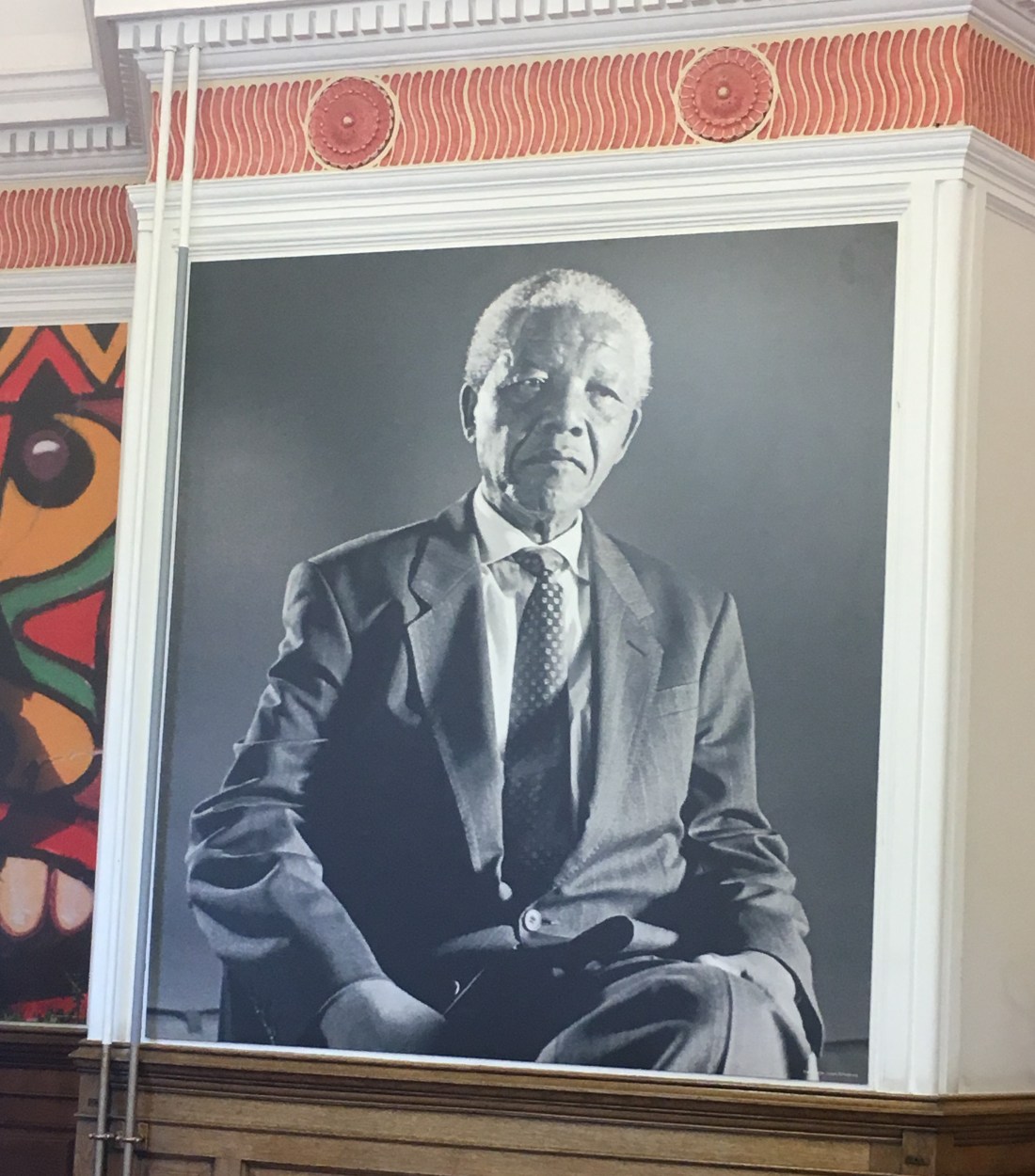
The meeting was held in the Mandela Room, which had an imposing life-sized photograph of Nelson Mandela on one of its walls:
We arrived at 3.00pm and enjoyed an initial half hour of networking over sandwiches, tea and Mzuzu coffee. Paul Garside and Andy Waters from the Institute of Infection, Inflammation & Immunity at the University of Glasgow were both in the room when we arrived and it was also good to catch up with Neil Merrylees and Remus Chunda from the University of Dundee.
Informal networking before the meeting began
The meeting was chaired by David Hope-Jones, Chief Executive of the Scotland-Malawi Partnership
David Hope-Jones gets the meeting underway
David Hope-Jones ran through the objectives of the meeting and how it would be structured.
The objectives of the meeting
After brief presentations from Stuart Brown (Deputy Chief Executive of the SMP), Kerry Chalmers (NHS Global Citizenship Programme) and Liz Grant (Edinburgh University), the bulk of the afternoon revolved around 2 minute presentations from each of the delegates. We were asked to specifically draw out:
Key successes
Key learning
Ideas for enhanced collaboration and coordination
Two minutes each – Kerry Chalmers in action here!
It was a fascinating afternoon with a broad range of subject specialists including, amongst others, those involved with research governance, climate science, pathology, oncology, water supply and sanitation, emergency medicine, drug discovery, tropical diseases, the non-communicable disease agenda and our own interest in oral health improvement.
Several common themes emerged:
Key successes
Working together at all levels, supported often by the Scotland-Malawi Partnership
Linkages across projects
Subject-specific achievements eg the Water Futures Programme managed through the University of Strathclyde
Key learning
The importance of listening to local needs
Cultural sensitivity
The massive potential of Malawi’s youth population
The need for even greater connectivity between projects
Ideas for enhanced collaboration and coordination
Improving communication between all those working on projects in Malawi
Knowing what each other are doing
Considering combined funding bids through multiple institutions
Organising more meetings like the one being held today
A number of those present, ourselves included, were due to attend a second event at the Scottish Parliament at 6.00pm, so after the closing remarks from David Hope-Jones, a small fleet of taxis transported us down the Royal Mile for a meeting of the Cross Party Group on Malawi.
Liam McArthur MSP opened the meeting by welcoming everyone present. After receiving apologies and approving the minutes of the last meeting, the core business of the evening started.
David Hope-Jones introducing Professor Bob Kalin, the first speaker
The first presentation was from Professor Bob Kalin, Professor of Environmental Engineering for Sustainability, and the Director of the Climate Justice Fund Water Futures Programme. He provided an overview and update on the recent Malawi floods, which have displaced 83,000 people from their homes, leading to creation of 187 camps. The swift and generous response of the Scottish Government had made a tremendous difference to the support that could be provided. Details are available at: https://www.scotland-malawipartnership.org/news-events/all-news/malawi-floods-update/
Angus Loudon listening to Bob Kalin, just before giving his presentation on behalf of St John Scotland
Following Professor Kalin’s presentation, Angus Loudon, Executive Director of St John Scotland, gave a report on the first six months of their Scottish Government-funded project ‘Community action and service access for maternal, newborn and child health’. The project has already made great progress, exceeding all the milestones set for this stage of the programme.
The third presentation was delivered by Mike McKirdy, Professional Advisor to the Scottish Government’s Scottish Global Health Co-ordination Unit. This relatively new unit is going from strength to strength in its ambition to share best practice and learning and to find ways to facilitate the involvement of NHS Scotland staff in global citizenship activities. There are now Champions in each health board area, a People Register for those interested in becoming involved and a Health Partnership Mapping function on the web-site (which includes an entry for the MalDent Project). Mike paid tribute to the hard work of Kerry Chalmers who is the Programme Manager.
Mike McKirdy providing an update on the work of the Scottish Global Health Co-ordination Unit
After a period of open discussion, the formal part of the meeting closed and Malawian gin and tonics were served for a final networking opportunity.
Partners in the MalDent Project: (L to R) Niall Rogerson and myself (University of Glasgow); Mike McKirdy (RCPSG); Peter Mossey, Remus Chunda & Neil Merrylees (University of Dundee)
This had been an enjoyable, interesting and extremely valuable afternoon and evening.
Whilst improvements are always possible, I am very grateful for the coordination and connectivity of those of us who work in Scotland and are engaged in development projects in Malawi. The Scottish Government, Scotland-Malawi Partnership, Malawi-Scotland Partnership, Scottish Global Health Coordination Unit, health boards and educational establishments are developing a very strong inter-disciplinary network of colleagues, all of whom have the common aim of establishing community-led partnerships between the two nations. The MalDent Project benefits greatly from this supportive and collegiate environment.
The Scottish Dental Show was held at Glasgow’s Braehead Arena on 26th and 27th April 2019. Bridge2Aid had a stand and Dentaid agreed to share its stand with Smileawi, so this provided an ideal opportunity for Niall Rogerson and I to visit the show and meet with colleagues from the charities which are supporting the MalDent Project.
Arriving at the Scottish Dental Show
After grabbing a sandwich and a cup of tea, we headed to the Bridge2Aid stand, where we spent a very enjoyable and interesting hour with Paul Tasman, the Operations Manager. Bridge2Aid is currently awaiting the outcome of an application to the Tropical Hygiene and Education Trust (THET) to fund the establishment of a partnership with the Dental Association of Malawi. The longer-term goal of the partnership, in conjunction with the MalDent Project and Smileawi, is to establish dental training programmes in rural Malawi for Clinical Officers who will be taught to undertake emergency dentistry. This model has been developed very successfully over 15 years by Bridge2Aid in Tanzania and was the subject of a previous blog post. Paul will visit Malawi in June to meet key stakeholders, including officials in the Ministry of Health, as an initial step in the process and Shaenna Loughnane, the CEO of Bridge2Aid, will visit in September.
Niall Rogerson, Paul Tasman and I at the Bridge2Aid stand – lots to talk about and much to share
After our discussions with Paul, we moved to the Dentaid / Smileawi stand, which was a very busy place! It was great to catch up with Jacqueline James, Overseas Projects & Volunteering Manager for Dentaid, and Stuart Little who is a fellow Edinburgh dental alumnus who is closely associated with Dentaid. Vicky Milne from Smileawi was also present with some of her team. In addition to covering off some business linked to our activities in Malawi, we also enjoyed some chat about the KiltWalk, due to take place on the following Sunday over 23 miles from Glasgow Green to Balloch on Loch Lomond. Smileawi and the Royal College of Physicians & Surgeons of Glasgow both had teams taking part, with Vicky and myself among them.
Lots of interest from delegates at the Dentaid / Smileawi stand
Dentaid had their new pop-up poster displayed, with some very impressive numbers reflecting the many ways in which their activities are supporting dental healthcare globally.
Dentaid – improving the world’s oral health
One of the most exciting aspects of the MalDent Project is the way in which a number of organisations are working together in support of common aims. The shared ‘base camp’ between Dentaid and Smileawi was reflective of this ethos.
Dentaid, Smileawi and the MalDent Project – working together
As we left the show, Niall and I reflected on the enthusiasm and excitement that had underpinned all our discussions. The involvement of Bridge2Aid, Dentaid and Smileawi with the MalDent Project is making a tremendous difference to what can be achieved – the power of partnership.
For those who may be wondering how the KiltWalk turned out, both teams survived and the donations are still accumulating. Many thanks to all our generous sponsors! Here are some scenes from the day:
Nigel and Vicky Milne with other Smileawi team walkers hit ‘The Mighty Stride’The Royal College of Physicians & Surgeons of Glasgow HOPE Foundation team in action – a great day for a great cause.
After a massive amount of work on the part of many people and organisations, the content of the BDS curriculum for the new Dentistry programme at the University of Malawi College of Medicine has been approved. Peter Chimimba has sent me a photo of the front cover of a bound copy of the curriculum, hot off the press:
Curriculum approved – we’re off the blocks!
The photo below, taken during the National Dental Curriculum Conference in Mangochi in November 2018, includes many of those who participated in the process and whose input has contributed to this success.
The BDS curriculum team
One of the immediate results is that the pull-up banners, which advertise the undergraduate courses now on offer at the College of Medicine, have had to be replaced with a new version that includes the Bachelor of Dental Surgery!
The revised banner. The arrow was added by the author!
Now that the curriculum has been approved, the focus of work will shift to student recruitment, with a view to accepting the first cohort of BDS students in August 2019. This work is already underway:
A new opportunity
The start of a brand new programme is always challenging in any Higher Education Institution, and there is lots of work to do moving forward. However, the train has left the station and the journey has begun!
Those who are following our blog will remember seeing in December the dental chairs, pre-clinical skills equipment and a variety of other items packed into a shipping container by Stuart Bassham and his colleagues at Dentaid, in Salisbury. They left on a truck bound for Southampton and then to be sent by sea to Mozambique before the overland journey up to Malawi.
In February we received confirmation that the container had reached Mozambique, but shortly afterwards Cyclone Idai arrived, causing severe damage in Mozambique, Zimbabwe and Malawi. The devastation affected millions of people with extensive loss of life as well as massive damage to homes and infrastructure, which is going to have a very long term impact.
On 28th March, we received a message from Peter Chimimba, our Project Lead in Malawi, to say that the container would soon arrive in Lilongwe and a few days later, after customs clearance, the truck bearing the container rolled into the grounds of the College of Medicine campus at Lilongwe.
A welcome sight – the container of equipment arriving in Lilongwe
When the container doors were opened, the contents were all intact despite the long journey and the storm:
It’s good to know that the equipment is now safely stowed indoors and awaiting installation:
Stuart Bassham and Terry Bristow from Dentaid will be joined by Jonathan Langley, an engineer with Henry Schein, from 9th-15th May in Lilongwe, to undertake the installation of the equipment. We’ll report on progress in a later post.
Many thanks to Scottish Government International Development for the grant that has allowed the re-purposing and transportation of the dental chairs donated by NHS Greater Glasgow & Clyde, and to Dentaid and Henry Schein for their tremendous ongoing support.
There is a paucity of data on the epidemiology of oral disease in children in Malawi, and one of the elements of the MalDent Project will be to undertake a national child oral health survey. In the interim, Nigel and Vicky Milne had approached Glasgow Dental School to enquire whether we had any students who may be interested in working with Smileawi on an elective project to undertake a pilot child oral health survey in Northern Malawi, within the areas in which they now have many contacts.
In an earlier blog post we reported on the interest that was aroused at the Dental School Electives Evening last Autumn, when Nigel presented about Smileawi’s work. As a result, four Glasgow BDS 4 students and one student from Dundee Dental School will be collaborating with Smileawi on a child oral health survey in June. Two other Glasgow BDS 4 students who will be visiting the University of Malawi College of Medicine in June will also spend some time with the Smileawi team.
Profs Lorna Macpherson and David Conway are leading on the training and preparation of the paperwork and database. On Friday 22 March they delivered an excellent planning session and provided training based upon the Scottish National Dental Inspection Programme protocol.
Profs David Conway and Lorna Macpherson prepare to get the afternoon underway
Introductions were made and it was good to see the Smileawi team, University of Glasgow staff and students and a student from Dundee Dental School interacting in such a positive way.
Nigel and Vicky Milne introduce themselves and Smileawi to the group
It was a return to the classroom in their alma mater for Nigel and Vicky, who were clearly enjoying themselves greatly:
It was an intense afternoon of work, but everyone was still smiling by the end of it:
What a team – partnership in action!
There was plenty of on-line homework set for the participants to complete ahead of the next meeting. Next time there will a trial run of the standardised caries detection and charting skills learned on-line at home, in conjunction with testing out the paperwork which will be completed in the field, together with the bespoke database that is under construction for data entry. The project is coming alive!
About a month ago I called Nigel and Vicky Milne to sort out some of the logistics around the forthcoming visit that some of our students will be making to Malawi in June to work with Smileawi on an epidemiology project (see next post).
At the end of the call, Nigel asked if I could do him and Vicky a favour by attending the Faculty of General Dental Practice Dinner in London on Friday 15th March to collect an award on their behalf, since they would both be out of the country at the time. As it happened, I was attending the dinner anyway to represent the Dental Faculty of the Royal College of Physicians & Surgeons of Glasgow and I was both honoured and delighted that I had been asked to act as a proxy for Nigel and Vicky.
The event was held at The May Fair Hotel in Stratton Street, London.
The grand setting of The May Fair Hotel, London
It was a tremendous evening in the hotel’s Crystal Room. A good number of my friends and colleagues from the West of Scotland FGDP section were present and I also very much enjoyed catching up with John Milne, the Senior National Dental Adviser for the Care Quality Commission, who I had met in Tanzania on the Bridge2Aid Dental Training Programme in September 2018 (see previous post).
The Dean and guests enjoying the very convivial atmosphere of the FGDP Dinner
Dr Ian Mills, Dean of the FGDP, described the history of Smileawi, the charity established by Nigel and Vicky Milne that is working in many different ways to improve oral health in Northern Malawi. It is quite incredible to reflect on all that has been achieved, in a relatively short space of time, by these two dental practitioners, who also run a busy dental practice in Dunoon on the west coast of Scotland.
The Dean of the FGDP, Dr Ian Mills, describing the work of Nigel and Vicky Milne, founders of the charity Smileawi
l was delighted to be given the opportunity to say a few words before collecting the award on behalf of Nigel and Vicky. Not only am I hugely impressed by what they have achieved and continue to achieve, but I am very grateful for their collaborative ethos. One of the ongoing challenges for all those involved in international development work is the joining up of many individual projects where there are synergies that can combine to increase impact and sustainability. In that context I mentioned the developing links between Smileawi, Dentaid, Bridge2Aid and our own MalDent Project, together with dental industry partners, which will allow us to extract maximum benefit when working with our colleagues in Malawi.
Delivering a short acceptance speech on behalf of Nigel and Vicky
The award was then entrusted to me for temporary safe-keeping and transportation up to Scotland to meet its rightful owners
Accepting the Dean’ s award from Ian Mills, on behalf of Nigel and Vicky
On Friday 22nd March, Nigel and Vicky were at Glasgow Dental School for a training event (see next post). This was my opportunity to do the presenting as a proxy for Ian Mills. Unfortunately it wasn’t as grand as the real thing at the May Fair Hotel (not a robe in sight!) but I think it’s clear from the smiles just how delighted they are!
The final phase of the award process … at last it’s in the hands of the winners!
If you would like to read more about this years FGDP awards, you can do so at https://www.fgdp.org.uk
The Wellcome Centre for Integrative Parasitology proudly displayed at the Glasgow Science Centre
Dr Mwapatsa Mipando, Principal of the University of Malawi College of Medicine, had travelled from Malawi to Glasgow to participate in the symposium and was the final speaker of the day.
By chance, I had already agreed to give a short presentation to the Rotary Club of Ayr about the MalDent Project on the evening of 26 February. I had met Ieuan and Alex, both members of the Rotary Club of Ayr, at the Scotland-Malawi Partnership AGM last Autumn when I was speaking with them about their link to work with Professor Bob Kalin at the University of Strathclyde on water infrastructure projects in Malawi (see below!).
I was delighted when it was agreed that Mwapatsa would be able to accompany Niall Rogerson and myself down to Ayr. We picked Mwapatsa up at the Glasgow Science Centre immediately after he had delivered his lecture at the WCIP meeting and whisked him through heavy rush hour traffic to the Rotary Club meeting at the Savoy Park Hotel in Ayr.
Our destination: the Savoy Park Hotel in Ayr
Once in the lobby we knew we were in the right place!
We arrived in time to enjoy a very tasty dinner before I was invited to speak at 7pm.
Enjoying dinner and great conversation courtesy of the Rotary Club of Ayr
Following my talk, Mwapatsa was also invited to say a few words before the President of the Club invited questions and then closed the meeting.
I was delighted that Bob Kalin, from Strathclyde University, was in the audience. The amazing work that he and his team are doing on water infrastructure projects was well known to me after hearing him speak at meetings organised by the Scotland-Malawi Partnership and Scottish Government. After the meeting we had a very interesting conversation about an ongoing project of Bob’s on fluoride concentrations in groundwater in Malawi. He showed us a fantastic app which plots every bore hole in the country, links each one to other key local data and which is about to be used in a planned survey on dental fluorosis.
Myself, Mwapatsa, Bob and Niall after our discussion about future partnership working
Subsequent to that discussion, Bob and his PhD student Marc Addison have met with Prof Lorna Macpherson (Professor of Dental Public Health at Glasgow Dental School), Niall and I to establish some joint working on this project – a very exciting prospect which has sprung from initial connections facilitated by the Scotland Malawi Partnership AGM.
Before leaving the Savoy Park Hotel I spied this gem of a plaque on the wall:
No trip to Ayrshire is complete without reference to Scotland’s National Poet and this one seemed particularly apt for the evening in view of the coincidence of dates that had resulted in Mwapatsa attending the meeting.
Many thanks to the Rotary Club of Ayr for their interest in the MalDent Project and for their generous hospitality – it was a tremendous evening.
My good friend Alex Mackay had arranged for me to meet again with Mwapatsa on the Thursday afternoon of his visit. By chance, a student from the University of Rwanda Dental School, Karebu Bizumuremyi, was visiting Glasgow Dental School on a two week programme from 25th February to 8th March. This had been organised by Niall Rogerson, who has played a significant role over the past four years supporting the introduction of the BDS curriculum in the new Rwanda Dental School. The first cohort of students had graduated in 2018 and Mwapatsa was keen to have a chat with Karebu about his undergraduate experiences in Rwanda so far.
With Niall, Karebu and Mwapatsa after our joint meeting
We then discussed various items of MalDent Project business. Deirdre Kelliher, who is providing outstanding grant management support, joined us to discuss budgetary issues ahead of the first report that we will need to submit to the Scottish Government by 30 April 2019.
Log frames, budget documents, collaboration agreements, spreadsheets … Deirdre and Mwapatsa have it under control!
Following the two coincidences of our visit to Ayr and Karebu’s visit linking with Mwapatsa’s time in Glasgow, there was a third and final coincidence. On that Thursday evening, the Scotland Malawi Partnership had arranged a preview showing of the film ‘The Boy who Harnessed the Wind’, ahead of its official Netflix launch:
The film, shot in Malawi, tells the story of 13 year old William Kamkwamba, living in a rural village, who built a wind turbine from scrap materials to power electrical appliances for activities such as irrigation.
Alex had arranged tickets for Prof Paul Garside and his family and for Mwapatsa and myself. The screening was at the Dominion Cinema in Morningside, Edinburgh. We left Glasgow at 4.30pm and drove through to Edinburgh, arriving early enough to park very close to the cinema. Mwapatsa and I enjoyed a meal in a nearby Nepalese restaurant, before joining the queue for the film alongside Paul and his family.
On the red carpet … nearly at the head of the queue!
I had not been in the Dominion Cinema since I was a student nearly 40 years ago. It is a very plush picture house. The foyer had a fantastic Malawian flavour for the evening and we took advantage of the photo opportunity provided:
We were offered a Malawian gin on arrival in the body of the cinema and then welcomed by David Hope Jones, CEO of the Scotland-Malawi Partnership. Short videos demonstrating the fantastic work of the event’s two main sponsors, Orbis Expeditions (http://www.orbis-expeditions.com/) and Brewgooder (http://www.brewgooder.com), were shown followed by a videocast welcome from William Kamkwamba, the character on whom the film was based. He had hoped to be present in person, but instead was in the USA for the official launch of the film on Netflix.
The film itself was superb – if you have access to Netflix then please watch it. The importance of education could not be illustrated more forcefully.
After the film, we headed back to Glasgow. Paul’s daughter lives in Edinburgh and took a taxi home, but I was able to give Paul and his wife, along with Nicola Cogan who oversees our project grant at Scottish Government, a lift home.
It is a privilege to be part of the various collaborations that have developed between the College of Medicine in Malawi, the University of Glasgow and the multiple other partners that are now coming on board with the MalDent Project. There are exciting times ahead!