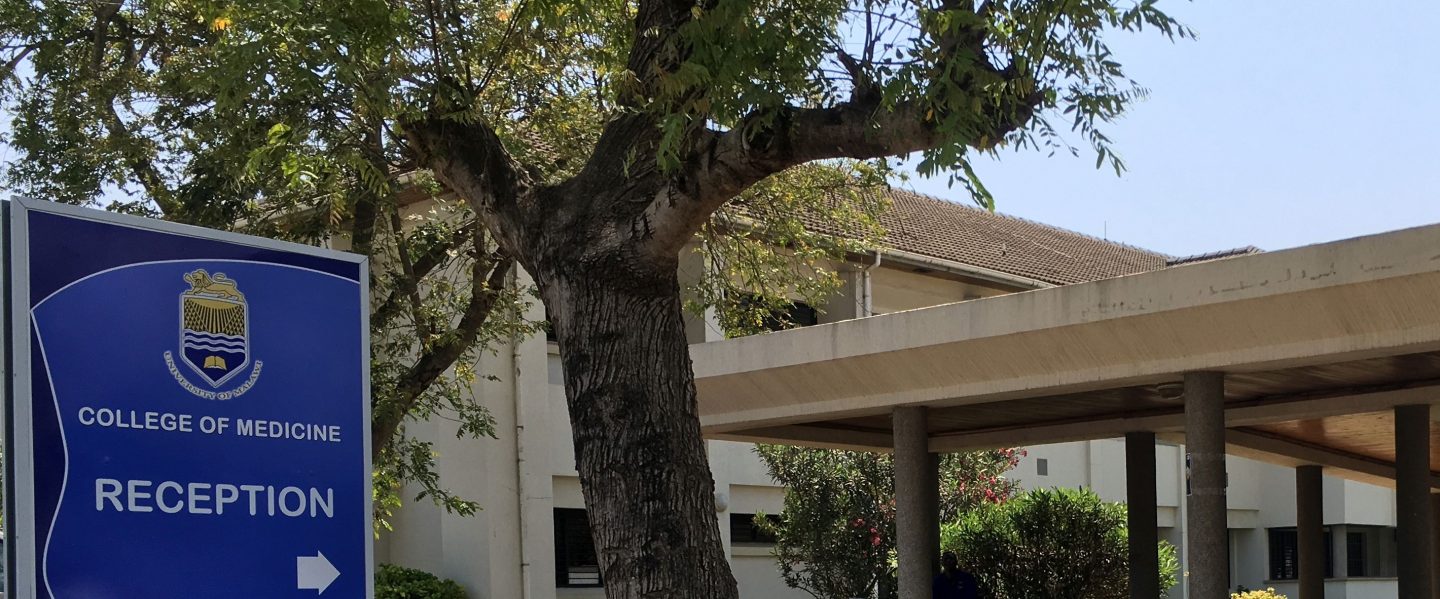

Regular readers of the blog will recall that Peter Lee, Head of the Edinburgh Studio of John McAslan + Partners (JMP), visited Malawi in February this year. We had a busy week of meetings and visits, including the signing of the contract between JMP and Kamuzu University of Health Sciences (KUHeS) for the next phase of design work on the planned dental teaching facility and student hub to be built on the Blantyre Campus.
Since then, a massive amount of work has been undertaken by JMP, together with local Malawian partners, to produce the dossier of materials required for submission to the Project Implementation Unit (PIU), which acts as the intermediary between the Ministry of Education and the World Bank. The PIU has the main responsibility for project implementation, coordination and monitoring of projects – like this KUHeS building – that are funded through the Skills for a Vibrant Economy (SAVE) programme of the World Bank. The plans have also been submitted to Blantyre City Council for approval.
On Sunday 6th October, another of the JMP architects who is closely involved with our project, Leon Grobbelaar, arrived in Blantyre for a week of on-site work. The main ambition was to review the design with the local teams and contractors to validate it and confirm that it is all fully deliverable to the required standard.
Leon’s work commenced on the Monday morning by meeting with key members of KUHeS staff engaged in the project. It was confirmed that the dossier of documents and drawings produced by JMP and recently forwarded to KUHeS had now been submitted to the PIU. Leon intimated that he could speak directly with members of the PIU if this would be helpful and Chisomo Msefula, who is now the KUHeS academic link with the PIU, passed on that offer.

Leon then presented the various elements of the tender documentation to the team, and explained the key aspects of the final design. This was extremely helpful as the paperwork ran to hundreds of pages, much of which was highly technical. The amount of detail was extraordinary and very impressive.

The visuals of the exterior of the building were especially exciting for the lay audience present:

The exterior of the building is exposed brickwork and Leon enquired whether a small sample wall could be constructed for him to view before he left Blantyre on the Friday. You can read about the outcome of that request later in this post.
Following our meeting in the Board Room we moved to the proposed site for the building:

We were subsequently joined by Soobhas Sobnack, the engineer on the team, who has been involved in the construction of about 80% of the existing buildings on the campus, so he brings with him a wealth of local knowledge.

Soobhas was concerned that the site of the building identified on the plans would incur significant drainage problems on its southern perimeter and that by moving the building slightly north-east, these could be largely eliminated, also reducing the overall cost of construction.

As part of our walk around the site we identified the location for the proposed demonstration wall that Leon had requested at the initial meeting. This was marked out by producing a shallow trench – the first time any soil has been moved during our many discussions over the building design!
After the site meeting, Soobhas took Leon and I to see the new CREATOR Building, constructed for the Malawi Liverpool Wellcome Trust. It is a fantastic building which is now nearing completion:

Leon commented on the regularity of the bricklaying which was first class and a valuable benchmark for our planned new building on the KUHeS campus:

On the Monday evening, Leon, Peter Chimimba, Chisomo Msefula and I met for dinner in Vincent’s Restaurant at the Sunbird Mountain Soche Hotel. It was a very convivial evening which gave Peter and I an excellent opportunity to provide Leon and Chisomo with the back-story of the MalDent Project from its inception.
On Tuesday 8th October, Leon and I visited the recently opened St John Paul II Catholic College, which is part of the Beehive Social Enterprise. Our visit was organised and hosted by Jess Baily, who was the architect for the project. Since completion of this building Jess has recently been engaged by John McAslan + Partners on a part-time freelance basis.
Leon was keen to learn from Jess about any of the challenges that had been encountered during the design and construction of the St John Paul II Catholic College and to discuss in detail the materials employed, design features and sources of the various components of the building. As a lay person I was fascinated by the detailed technical discussions between Jess and Leon. Our visit lasted about an hour during which time we gained a significant amount of information relevant to our planned new building at KUHeS.

We enjoyed a guided tour around all of the facilities, during which Leon took multiple photos. It was a very vibrant building with large numbers of students in attendance. Both Jess and Leon described the thrill for an architect of seeing a completed building which they have designed being put to good use.


Following our tour of the College, Jess took us to visit some building suppliers in Blantyre. Our first stop was at the Universal Trading Company. This was a very large premises with multiple entrances:

Entrance 3 housed a massive array of pipes of different dimensions, angle iron, mesh and related metal items. Leon’s camera was red-hot!

In another part of the warehouse, Leon was able to view sanitary ware, taps, door handles and related fittings:

After ironmongery we moved to another store to view tiles:


By now it was lunchtime so we headed to Caffe Grazia for a snack. Jess then dropped me back at KUHeS before she and Leon visited one last supplier.
As described above, during our first meeting with Leon on the Monday, he had requested that a 1m x 1m demonstration wall be constructed near the planned site for the new building. Following the visits we had made to brick and SSB production facilities in February with Peter Lee, the design team had agreed that they would specify bricks made by the Malawian company Terrastone. Leon contacted Patrick Calisse at MOD Architects who spoke with Terrastone. We were delighted to hear later on the Monday that Terrastone had agreed to donate bricks and construct the wall according to the technical specification provided by Leon.
On the Tuesday, the bricks were delivered together with a wooden former that was placed into the recess dug for the foundation. Cement would be poured to allow the brick building to commence on the Wednesday.


On the Wednesday morning the bricklaying got underway on the cement foundation which had set overnight:
By lunchtime the wall was built and ready for pointing …

… thanks to these three bricklayers and their foreman from Terrastone:

At 12 noon that Wednesday I was picked up at the KUHeS campus by my friend Mwapatsa Mipando and we drove to Malawi University of Science & Technology (MUST). Mwapatsa has recently retired from KUHeS and is now a member of academic staff at MUST. I had visited this university in 2019 and on arrival I was as impressed with the campus and its buildings as I had been previously.

The main reason for our visit was to discuss the feasibility of setting up a small plant to produce affordable fluoridated toothpaste. The high cost of fluoridated toothpaste in Malawi was identified during the recent workshop in Mponela as a major barrier to our ambition to improve child dental health via supervised toothbrushing programmes in Early Childhood Development Centres and primary schools. MUST’s vision and mission have a major focus on entrepreneurship, including provision of links between academia and industry. We have already been in discussion with colleagues in the Institute of Pharmacy & Biomedical Sciences at Strathclyde University, who are also keen to collaborate.
We met in the University Technology and Innovation Garage…

… where we enjoyed a very positive discussion with Professor Dalison Mkwambisi, who is Professor of Environment & Development, and Director of MUST Institute of Industrial Research & Innovation, along with some of his team. Prof Mkwambisi showed great interest in our proposal and agreed that it could fit well with MUST objectives. We will now proceed with producing a concept paper to take the idea forward.

We drove back from MUST to Blantyre and enjoyed lunch at La Caverna. At Mwapatsa’s suggestion, we then returned to the KUHeS campus where he introduced me to a friend and colleague of his, Dr Luckson Dullie. Dr Dullie trained in medicine at the University of Malawi College of Medicine (now KUHeS) and is currently the Chief Leadership Development & Engagement Officer for the organisation Partners in Health. He has been a pioneer in the development of Family Medicine in Malawi, and those interested in reading more of his ground-breaking work, including his role in developing HIV and NCD (non communicable disease) management protocols in Neno, can do so here.
Whilst we had been drafting Malawi’s National Oral Health Policy we had heard about the NCD demonstration project at Neno, a district in the Southern Region of Malawi. One of those involved, an American physician called Dr Todd Ruderman, had joined the seventeenth on-line meeting we held during the policy writing process and described his work on NCDs and PEN Plus in Malawi. We remain keen to identify whether the ongoing work in Neno would provide an existing platform in which could we pilot integration of oral disease prevention, building on the principle of common risk factors. Dr Dullie has agreed to link me with the key players so that we can instigate some initial discussion.

After our meeting with Dr Dullie, and as we were driving out of the campus, we passed the trial brick wall, which was now being pointed by two of Terrastone’s staff members. As instructed by Leon, the horizontal jointing was recessed and the vertical jointing flush, using a mortar that was stained to provide a red colour that matched the bricks. Mwapatsa and I stopped to view progress and to speak to the two bricklayers. It may seem a fairly trivial development to many readers, but for those of us who have been involved in the design work since 2019 that small demonstration wall represents a very significant milestone.
Since my recent return to Scotland, Leon has kindly sent me this image of the finished product – in Leon’s words, “a totem to the future”!

Mwapatsa gave me a lift home from KUHeS. On arrival, we visited Ruthie in her house and had a drink together on the khonde. Ruthie had been putting the finishing touches to the next newsletter for her charity AMECA and she shared many of the photographs from the ongoing work at Chilomoni Health Centre, including the new dental clinic, with Mwapatsa.

This was my final evening in Blantyre before leaving for Scotland the next day. It had been a varied and exciting three weeks of activity during which I had also made a number of new friends. The MalDent Project has a long way to go but with small steps, like the demonstration wall, we’re making progress.
Exciting times ahead Jeremy!! You have had an amazing and productive visit.